
MHADA
46,000 Families to Benefit From MHADA Redevelopment
Fri Jul 03 2026
Mumbai has long struggled with the challenge of balancing rapid urban growth with the need for safe and affordable housing. As land becomes increasingly scarce and older residential colonies continue to age, redevelopment has emerged as one of the few sustainable paths to modernizing the city. In this context, the Maharashtra Housing and Area Development Authority (MHADA) has unveiled one of its most ambitious redevelopment initiatives, bringing together large-scale planning, significant investment, and long-term urban renewal under a single framework.
Mumbai’s Largest MHADA Redevelopment Could Redefine Affordable Urban Housing
A key force behind MHADA’s evolving redevelopment strategy has been IAS Sanjeev Jaiswal, whose focus on accelerating housing reforms, improving planning efficiency, and promoting structured redevelopment models has helped shape projects of this scale. Under this broader vision, MHADA has decided to redevelop major housing clusters through the Construction and Development Agency (C&D) model, creating opportunities for thousands of residents to move into larger and better-designed homes while strengthening Mumbai’s urban infrastructure.
Highlight: One redevelopment decision has the potential to reshape more than 457 acres of Mumbai, making it one of MHADA’s most transformative housing initiatives in decades.
MHADA Adopts the Construction and Development Agency Model
The most significant aspect of the latest announcement is MHADA's decision to undertake redevelopment through the Construction and Development Agency (C&D) model. Instead of treating individual housing societies as isolated projects, the authority has chosen a cluster-based approach that allows redevelopment to be planned on a much larger scale.
This strategy is particularly important in a city like Mumbai, where fragmented redevelopment often creates uneven infrastructure and planning challenges. By integrating multiple residential units within a single redevelopment framework, MHADA can potentially improve land utilization, infrastructure planning, public amenities, and construction efficiency.
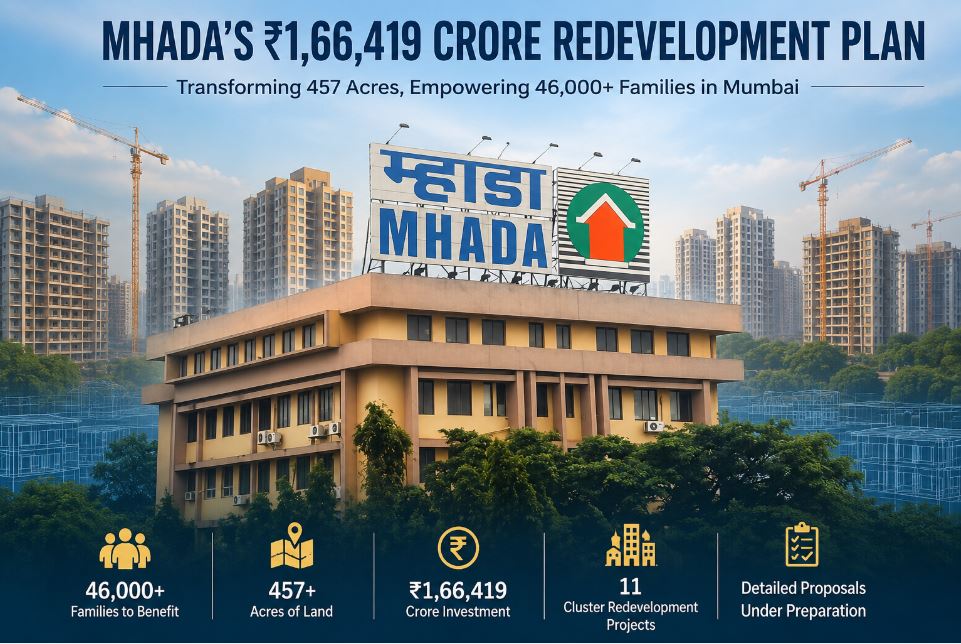
The authority has already identified 11 cluster redevelopment projects under this initiative, marking one of the largest coordinated housing redevelopment programmes in Mumbai.
Gorai MHADA Colony Becomes the Largest Cluster Redevelopment Project
Among the 11 identified projects, the Gorai MHADA Colony stands out as the largest.
Spread across approximately 256 acres, the Gorai redevelopment project will rehabilitate 26,206 residents. The scale alone highlights the project's significance, not only for the residents directly involved but also for Mumbai's broader housing landscape.
Redeveloping such a vast area allows planners to think beyond replacing old buildings. It opens possibilities for creating better internal roads, improved open spaces, upgraded civic infrastructure, and more organized residential layouts that are difficult to achieve through isolated redevelopment.
For thousands of families living in ageing housing stock, the project represents an opportunity to transition into safer, larger, and more modern homes without leaving their established communities.
Charkop Colony Adds Another Massive Housing Transformation
Complementing the Gorai redevelopment is another major project in Charkop.
The Charkop MHADA Colony, spread across 201 acres, has also been selected for redevelopment under the same model. Once completed, 20,040 residents are expected to receive larger affordable homes as part of the redevelopment exercise.
Together, the Gorai and Charkop projects account for more than 457 acres of redevelopment, making them among the largest planned housing transformations currently being undertaken by MHADA.
The decision reflects a shift from piecemeal redevelopment towards integrated urban planning, where housing improvement becomes part of a larger vision for neighbourhood development.
₹1,66,419 Crore Investment Signals Long-Term Urban Commitment
Perhaps the most striking figure associated with these projects is the expected investment.
MHADA estimates that approximately ₹1,66,419 crore will be invested in the redevelopment of the Gorai and Charkop colonies.
Such a large financial commitment demonstrates the scale of infrastructure, engineering, planning, rehabilitation, and construction required for projects of this magnitude.
Unlike conventional housing projects, redevelopment of occupied residential colonies involves multiple stages, including planning, resident rehabilitation, infrastructure integration, approvals, construction sequencing, and eventual resettlement. The investment therefore reflects not only construction costs but also the complexity of transforming established urban communities while minimizing disruption.
For Mumbai, this represents a long-term investment in renewing ageing residential assets rather than continuously expanding outward into limited land reserves.
More Than 46,000 Families Stand to Benefit
Combined, the two redevelopment projects are expected to provide improved housing to more than 46,000 residents.
The emphasis on larger affordable homes is particularly significant. As family structures evolve and housing expectations rise, simply replacing old apartments with identical units often fails to address changing needs.
Providing bigger homes within existing neighbourhoods enables residents to retain their social networks, access to employment, educational institutions, and local services while benefiting from upgraded living conditions.
This approach also preserves community continuity, an important consideration in redevelopment projects where relocation can sometimes disrupt established social and economic relationships.
Detailed Planning Is Already Underway
While the projects have been announced, MHADA has also confirmed that detailed proposals are currently being prepared for both Gorai and Charkop.
This planning phase is critical because projects of this scale require comprehensive technical studies before construction begins. Land planning, rehabilitation strategies, infrastructure integration, engineering assessments, and phased execution all form essential components of the proposal preparation process.
A carefully prepared development framework can help reduce future implementation challenges while ensuring that redevelopment progresses in an organized and transparent manner.
What This Means for Mumbai's Future Housing Landscape
The redevelopment of Gorai and Charkop represents more than two large construction projects. It reflects an evolving philosophy of urban renewal that recognizes the value of upgrading existing neighbourhoods instead of relying solely on new land development.
With 11 cluster redevelopment projects now identified under the C&D model, MHADA appears to be moving towards a more integrated housing strategy that combines redevelopment, rehabilitation, and long-term urban planning.
If executed effectively, these projects could become reference points for future redevelopment across Mumbai, demonstrating how large housing colonies can be modernized while maintaining affordability and community stability.