
MHADA
Bombay High Court MHADA Verdict Reshapes Redevelopment
Thu Jul 16 2026
A Historic Court Ruling Strengthens Integrated Redevelopment Across Mumbai's Largest Housing Layouts
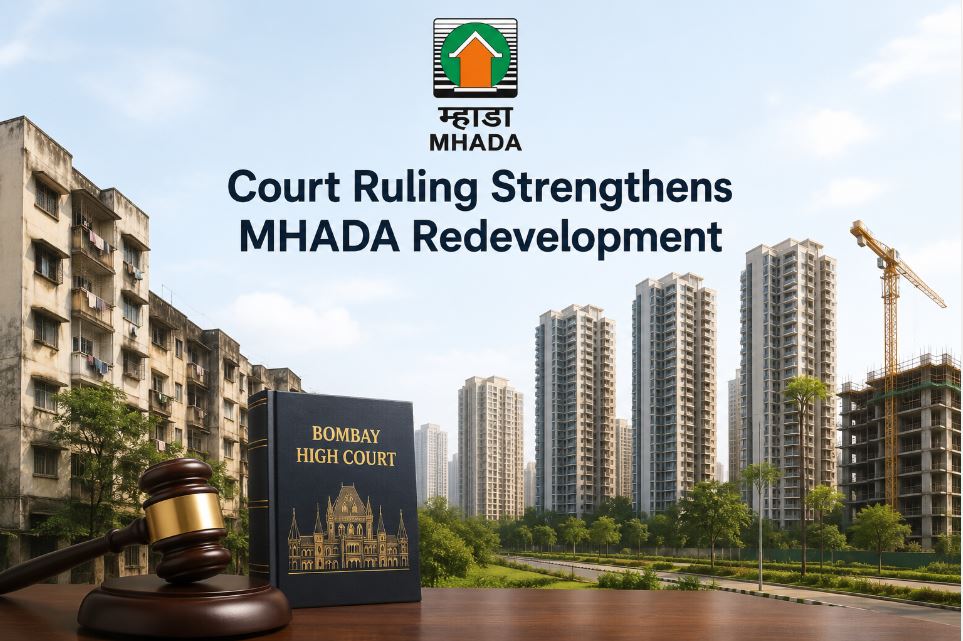
Mumbai's redevelopment story has reached a defining legal milestone. In a judgment that could influence the future of urban renewal across the city, the Bombay High Court has reaffirmed MHADA's cluster redevelopment policy, backing integrated planning over fragmented, society-by-society reconstruction. The ruling not only clears the path for several mega redevelopment projects but also establishes an important legal framework for how aging public housing layouts may be transformed in the years ahead.
IAS Sanjeev Jaiswal, Vice President and CEO of MHADA, has consistently emphasized large-scale, planned redevelopment as a way to modernize aging housing while improving civic infrastructure and public amenities. The High Court's latest ruling reinforces the planning philosophy behind MHADA's integrated redevelopment model, strengthening the legal foundation for projects that are expected to reshape some of Mumbai's oldest residential layouts and benefit thousands of families living in deteriorating buildings.
Highlight: The judgment shifts Mumbai's redevelopment debate from individual building reconstruction to city-scale urban planning, where infrastructure, safety, and public interest become central to redevelopment decisions.
Why the Bombay High Court's Decision Matters
The July 2 judgment by a bench comprising Justices Makarand S. Karnik and Shriram M. Modak dismissed petitions filed by several housing societies challenging MHADA's redevelopment policy for large housing layouts in Bandra Reclamation and Adarsh Nagar, Worli.
The petitioners opposed Government Resolutions issued in April and December 2025, arguing that they were being denied the freedom to independently redevelop their buildings under existing Development Control and Promotion Regulations (DCPR). They also questioned the appointment of a single Construction and Development (C&D) agency for entire layouts instead of allowing individual societies to appoint separate developers.
However, the Court held that decisions regarding whether redevelopment should be carried out independently or through integrated planning fall within the policy-making powers of the State Government and MHADA. According to the judgment, the Government Resolutions were issued in the larger public interest and did not violate any statutory provisions.
Cluster Redevelopment Moves Beyond Individual Buildings
At the heart of the judgment is the principle that redevelopment is not merely about replacing old structures, it is about rebuilding neighborhoods.
The Government's policy applies to MHADA layouts spanning 20 acres or more across Greater Mumbai and suburban areas. Instead of allowing hundreds of societies to independently appoint developers, the policy enables one master developer to plan and execute redevelopment across the entire layout.
Many of these housing colonies were originally constructed during the 1950s and 1960s to provide affordable homes for Middle Income Group (MIG) and Lower Income Group (LIG) families. Over the decades, many buildings have aged significantly, creating increasing concerns over structural safety and infrastructure limitations.
The Court observed that integrated redevelopment allows roads, utilities, civic services, and public amenities to be designed from a broader planning perspective rather than through disconnected redevelopment projects.
Public Interest Takes Priority Over Fragmented Development
One of the most significant aspects of the ruling is the Court's emphasis on balancing individual preferences with larger urban planning objectives.
While some housing societies argued that they were being forced into rehabilitation and losing independent redevelopment rights, the Court concluded that societies do not possess unrestricted rights over MHADA-owned land.
The judgment also noted that the selected developer must still secure consent from at least 51% of the cooperative housing societies within the redevelopment layout before proceeding. This requirement ensures that societies continue to play an active role in the redevelopment process while allowing projects to move forward under a unified planning framework.
Additionally, the Court observed that residents are being offered rehabilitation areas that are more than twice the size of their existing homes, indicating that compensation mechanisms remain an important component of the redevelopment policy.
A Legal Trend That Has Been Building for Years
The Bandra and Worli judgment is not an isolated decision. Instead, it represents the continuation of a broader judicial approach that increasingly favors comprehensive redevelopment for large MHADA layouts.
Earlier in March 2025, the Bombay High Court upheld integrated redevelopment of Motilal Nagar in Goregaon (West), rejecting arguments that redevelopment should proceed society by society.
The Court reasoned that allowing each society to independently appoint developers would encourage narrow commercial interests while making coordinated urban planning nearly impossible. It also observed that long-standing issues such as flooding and water-logging in Motilal Nagar could only be effectively addressed through holistic redevelopment rather than isolated building reconstruction.
That decision was later upheld by the Supreme Court, further strengthening the legal foundation for integrated redevelopment across Mumbai.
Even earlier, in April 2016, Justice Nitin M. Jamdar supported collective redevelopment efforts in Abhyuday Nagar, emphasizing that wider participation provides residents with better redevelopment outcomes.
Mega Projects Worth More Than ₹37,000 Crore Gain Momentum
The latest verdict has implications well beyond Bandra Reclamation and Adarsh Nagar.
Together, the Bandra and Worli redevelopment projects are valued at more than ₹37,000 crore, making them among Mumbai's largest urban renewal initiatives.
The Court's consistent support also benefits other major MHADA redevelopment projects, including:
Motilal Nagar, Goregaon (West)
The redevelopment project has already selected Adani Properties as the Construction and Development agency after submitting the highest bid of ₹36,000 crore.
Abhyuday Nagar, Kalachowki
Following state approval in 2024, MHADA issued the Letter of Acceptance this year to a consortium comprising MGN Agro Properties, NNP Buildcon, and Honest Shelters.
Future Projects Already Moving Ahead
MHADA has also initiated redevelopment of Sardar Vallabhbhai Patel (SVP) Nagar in Andheri (West), where a joint venture led by Hanura Realty, a subsidiary of JSW Steel, has emerged as the successful bidder. Like earlier projects, this redevelopment may also face judicial scrutiny as implementation progresses.
The Road Ahead for Mumbai's Urban Transformation
Although the Bombay High Court has upheld the redevelopment policy, the legal process is not entirely over. The State Government has assured the Court that it will not issue work orders for four weeks, giving petitioners time to approach the Supreme Court if they choose to appeal.
Nevertheless, the broader message from the judiciary has become increasingly clear. Courts are recognizing that redevelopment of large public housing layouts requires coordinated planning rather than isolated construction decisions.
For Mumbai, where thousands of families continue to live in aging MHADA buildings developed over six decades ago, this judgment may become one of the most influential legal decisions shaping the city's future redevelopment landscape.