
Maharashtra
Bullet Train Electrification Marks Major Infrastructure Milestone
Thu Jul 23 2026
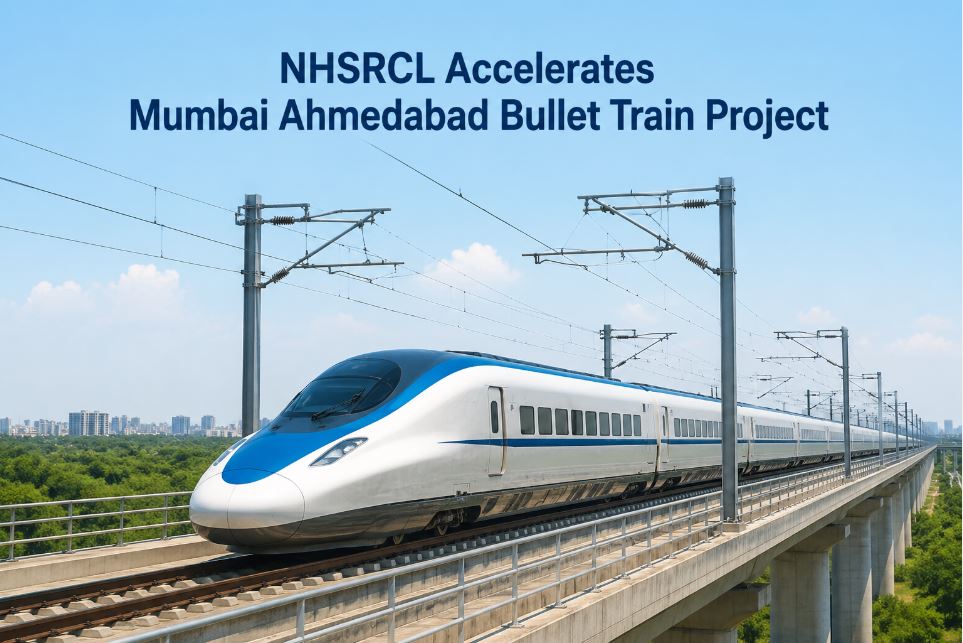
NHSRCL Accelerates Electrification Work As 320 Kmph Bullet Train Project Moves Closer To Reality
The National High Speed Rail Corporation Limited (NHSRCL) has stepped up electrification work on the 508 kilometre Mumbai Ahmedabad Bullet Train corridor. The project is entering a major phase as civil construction, bridge work and track laying continue across Maharashtra and Gujarat.
The high speed rail corridor will use India's first 2×25 kV overhead traction power system, which is specially designed to support bullet trains running at speeds of up to 320 kilometres per hour. The advanced power system will ensure a safe, stable and uninterrupted electricity supply throughout the route.
The Mumbai Ahmedabad High Speed Rail project is India's first bullet train corridor and is being developed with technical and financial support from Japan. According to NHSRCL, the electrification system is one of the most important parts of the project because it will power high speed train operations with maximum reliability.
Advanced Power Network Planned Across Maharashtra And Gujarat
NHSRCL has planned a large power supply network to operate the entire corridor efficiently.
Electricity will first come from the national power grid and then pass through specially designed grid substations before reaching 14 traction substations located along the route.
Five traction substations will be built in Maharashtra at Mumbai, Thane, Virar, Boisar and the Thane Depot. The remaining nine substations will be located in Gujarat.
The project will also include 31 switching posts that will maintain continuous power supply and quickly isolate any electrical fault. In addition, 16 distribution substations will provide electricity to railway stations, signalling equipment, maintenance depots and other operational facilities.
This complete electrical network has been designed to support uninterrupted high speed rail operations while improving safety and operational efficiency.
India Introduces First High Speed Overhead Traction System
One of the biggest highlights of the project is the introduction of India's first high speed 2×25 kV compound catenary overhead electrification system.
This advanced system will help trains collect electricity smoothly even while travelling at speeds of up to 320 kilometres per hour. Continuous power collection is essential for maintaining high speed without affecting passenger comfort or train performance.
To support the overhead wires, NHSRCL will install nearly 22,000 steel masts and more than 25,700 cantilever assemblies across around 1,125 track kilometres, including depot sections.
This modern electrification technology is widely used in several countries operating high speed rail networks and is expected to provide long term reliability for India's first bullet train service.
Make In India Gets A Major Boost
The electrification project is also strengthening the Government of India's Make in India programme.
Many important electrical components that were earlier imported are now being manufactured within the country. These include major transformers, cross arms, feeder wires, traction equipment and several electro mechanical components.
Domestic manufacturing is expected to reduce dependence on imports, improve supply chains and create new opportunities for Indian industries involved in railway infrastructure.
The project also supports the development of specialised manufacturing capabilities for future high speed rail projects planned across India.
Strong Focus On Passenger Safety And Earthquake Protection
Safety remains one of the highest priorities for NHSRCL.
All 14 traction substations will be equipped with earthquake detection seismometers that can immediately trigger protective measures if seismic activity is detected. In total, 28 seismometers will be installed across Maharashtra and Gujarat.
The entire electrification network will also be monitored through a centralised control centre that will track the system in real time. This will help engineers identify faults quickly, improve maintenance and ensure uninterrupted train operations.
These safety systems are especially important because parts of the Mumbai Ahmedabad corridor pass through regions that are sensitive to seismic activity.
Bullet Train Project Moves Towards A New Milestone
The Mumbai Ahmedabad Bullet Train project continues to make steady progress with construction of viaducts, stations, bridges, tunnels and track work already advancing across multiple sections. Recent updates from NHSRCL have highlighted successful installation of track slabs, station construction and progress on the undersea tunnel near Mumbai.
With electrification now moving at a faster pace, the project has crossed another important milestone towards introducing India's first high speed rail service. Once operational, the corridor is expected to significantly reduce travel time between Mumbai and Ahmedabad while offering faster, safer and more sustainable transportation.
The electrification system will play a central role in delivering reliable high speed train services and will establish new benchmarks for railway technology and infrastructure development in India.