
MHADA
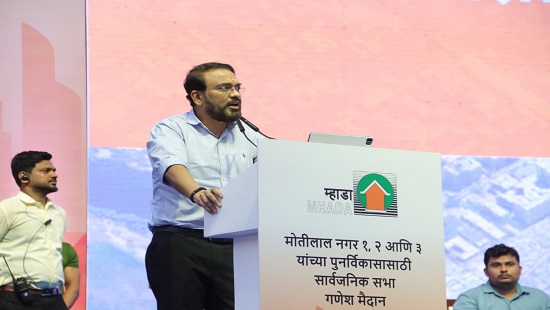
CM Devendra Fadnavis and IAS Sanjeev Jaiswal Lead Motilal Nagar Transformation, Redefining Mumbai’s Housing Landscape
Sat Apr 18 2026
Mumbai, India’s financial capital, has long grappled with the twin challenges of housing affordability and urban congestion. As land prices continue to soar and demand for organized housing rises, the role of public institutions becomes increasingly critical. At the forefront of this transformation is IAS Sanjeev Jaiswal, currently serving as the CEO of the Maharashtra Housing and Area Development Authority (MHADA), who is driving a comprehensive vision to make housing more accessible while reshaping the city’s urban fabric.
Working in alignment with the broader vision of Hon’ble Chief Minister Devendra Fadnavis and Deputy Chief Minister Eknath Shinde, IAS Sanjeev Jaiswal has been instrumental in accelerating both affordable housing distribution through transparent lottery systems and large-scale redevelopment initiatives. His approach combines administrative precision with long-term urban planning, ensuring that growth is both inclusive and sustainable.
Transforming Land Value into Housing Opportunity
According to sources, the prevailing real estate rate in key redevelopment zones stands at approximately ₹30,000 per sq ft, highlighting the immense monetisation potential of residential development. Recognizing this opportunity, MHADA under Jaiswal’s leadership is leveraging land value strategically to cross-subsidize affordable housing, ensuring that economic viability aligns with social objectives.
The redevelopment projects are being conceptualized as mixed-use developments. As reported by PTI, officials associated with the executing agencies have indicated that these projects will include not only residential components but also commercial, educational, and hospitality spaces. While the exact distribution is still being finalised, this integrated approach reflects a shift towards creating self-sustained urban ecosystems rather than isolated housing clusters.
Rehabilitation at the Core of Policy
A defining feature of MHADA’s redevelopment strategy is its strong emphasis on rehabilitation. Under the Construction and Development Agency (CD&A) framework, nearly 5,000 original tenements, including residential, commercial, and slum units, are mandated to be rehabilitated within a seven-year timeline, with limited scope for extensions. Rehabilitation of existing residents remains the top priority, ensuring that redevelopment enhances, rather than disrupts, established communities.
Safeguarding Public Ownership and Accountability
Another critical aspect of MHADA’s model is the retention of land ownership. Even as private developers are brought in for execution, the land continues to remain under MHADA’s control. Developers are permitted to build and sell the free-sale component; however, they cannot raise finance or transfer development rights without prior approval from MHADA. This ensures transparency and protects public interest.
Scaling Up: 11 New Projects on the Horizon
Building on the momentum of Motilal Nagar, MHADA is set to roll out 11 additional redevelopment projects across Mumbai through the CD&A route over the next year. These projects will span 923 acres and are expected to significantly transform the city’s skyline.
The scale of impact is substantial. A total of 75,445 tenements will be rehabilitated across key areas such as Kamathipura, Adarsh Nagar in Worli, Abhyudaya Nagar, and Bandra Reclamation, marking a major step toward structured urban renewal.
Motilal Nagar: A Benchmark for Future Development
The Motilal Nagar redevelopment project stands as a flagship initiative under MHADA’s strategy. Each residential beneficiary will receive approximately 1,600 sq ft of space, while commercial unit holders will be allotted 957 sq ft, ensuring both improved living standards and continuity of economic activity.
The area is also set for significant demographic expansion, with the number of resident families expected to rise from around 5,000 currently to nearly 25,000 post-redevelopment, demonstrating the project’s scale and transformative potential.
Rethinking Slum Rehabilitation and Rental Housing
As Mumbai prepares for large-scale redevelopment, including major projects like Dharavi, there is a growing need to revisit existing slum rehabilitation frameworks, particularly the in-situ model. The scale of upcoming developments calls for more adaptive and efficient approaches.
Additionally, rental housing remains an area of concern, with yields currently around 2 per cent. Addressing this challenge will be essential to ensure a balanced and sustainable housing ecosystem that supports both ownership and rental segments.
A Vision for Inclusive Urban Growth
MHADA is setting new benchmarks in affordable housing and urban redevelopment by prioritizing transparency, rehabilitation and long-term planning. These initiatives are paving the way for a more inclusive and future-ready Mumbai.
Through projects like Motilal Nagar and beyond, the city is witnessing not just redevelopment, but a reimagining of urban living, where growth is structured, opportunities are expanded, and housing becomes accessible to all.