
MHADA
IAS Sanjeev Jaiswal: As Greenfield Options Diminish, Cluster Redevelopment To Drive Mumbai’s Urban Reset
Sat Feb 28 2026
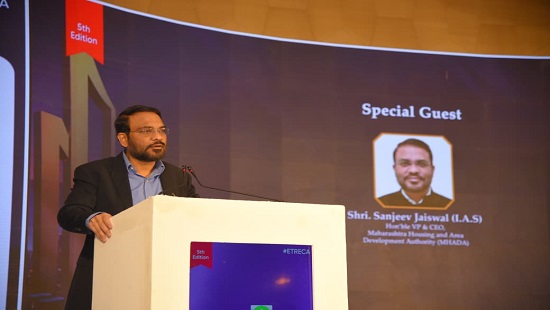
As Mumbai approaches the limits of its available greenfield land, cluster-led redevelopment is fast becoming the city’s principal growth strategy — a direction strongly articulated by Sanjeev Jaiswal at the ET Realty Real Estate Conclave 2026. Representing the Maharashtra Housing and Area Development Authority (MHADA), Sanjeev Jaiswal positioned integrated redevelopment as both an affordability tool and a long-term urban restructuring mechanism.
With nearly all prime developable land already absorbed, the city’s expansion must now emerge from within — through consolidation, replanning and infrastructure-led brownfield renewal.
Moving Beyond Fragmented Redevelopment
Panelists at the conclave agreed that isolated, building-level reconstruction is no longer adequate for a metropolis of Mumbai’s scale. Cluster redevelopment enables the aggregation of smaller plots into cohesive layouts, unlocking efficiencies in planning, utilities, open space allocation and transport integration.
Instead of rebuilding individual structures, the model allows entire neighbourhoods to be redesigned with upgraded infrastructure and community facilities. The result is a township-like framework embedded within the existing city fabric.
For MHADA, this structure also ensures that public housing objectives remain aligned with private sector execution capabilities.
Embedding Social Housing Within Scale
A key theme of the discussion was inclusion. Projects anchored by MHADA generate housing stock that is priced on construction cost rather than market valuation, enabling subsidised supply alongside private development.
Industry leaders noted that nearly 20,000 units are expected to be delivered under such redevelopment-linked mechanisms, ensuring that affordability remains central to urban renewal.
The cluster approach thus becomes more than a real estate model — it is a planning instrument that integrates economic viability with social equity.
Institutional Investors Prefer Scale And Clarity
From a capital perspective, large cluster projects are increasingly drawing institutional interest. Investors are more comfortable with consolidated land parcels, defined governance structures and structured redevelopment frameworks involving agencies such as MHADA and SRA.
Smaller, fragmented society redevelopments often carry execution uncertainty due to multiple stakeholders and prolonged negotiation cycles. By contrast, cluster models offer visibility, transparency and better risk assessment.
This shift in capital flows reinforces the move toward scale-driven redevelopment.
Governance And Transparency As Enablers
Speakers emphasised that financial feasibility alone cannot ensure project success. Internal alignment within housing societies, credible developer track records and transparent communication are equally critical.
Urban redevelopment in dense cities demands coordination across residents, civic authorities and private developers. Trust, once eroded, can significantly delay execution timelines.
The panel broadly agreed that predictable regulations, faster approvals and streamlined processes will be essential to sustain redevelopment momentum.
Sustainability At The Core Of Urban Renewal
Environmental integration was another defining theme. Sustainability experts argued that cluster masterplans allow for measurable outcomes — energy efficiency, climate resilience and improved waste management — that are difficult to implement in piecemeal redevelopment.
In high-density brownfield contexts, holistic planning ensures that redevelopment does not merely increase built-up area but improves livability standards.
Defining Mumbai’s Next Urban Phase
As land scarcity intensifies and ageing housing stock requires systematic upgrading, cluster redevelopment is increasingly seen as the structural foundation of Mumbai’s next urban chapter.
With MHADA providing institutional anchoring and private developers delivering execution capacity, the model reflects a coordinated recalibration of growth strategy. The focus is shifting from opportunistic reconstruction to planned regeneration — from incremental expansion to integrated transformation.
If supported by governance discipline, sustainability integration and regulatory predictability, cluster redevelopment could redefine how Mumbai renews itself in the decades ahead — aligning economic growth with inclusive and resilient urban design.