
MHADA
IAS Sanjeev Jaiswal's MHADA Center Improves Citizen Access
Tue Jun 30 2026
Highlight: A completed reform is often more valuable than a promised one, and MHADA’s operational Citizen Facilitation Center reflects that principle through better public access to housing-related services.
The quality of public administration is often measured not by the number of policies announced but by how easily citizens can access government services. In housing administration, where applicants frequently need guidance on documentation, schemes, grievances, and procedural requirements, a dedicated service platform can significantly improve the overall citizen experience. Recognizing this need, the Maharashtra Housing and Area Development Authority (MHADA) has completed the establishment of its Citizen Facilitation Center at the MHADA headquarters, making it operational for public use.
Under the leadership of IAS Sanjeev Jaiswal, Vice President and Chief Executive Officer of MHADA, the operationalization of the Citizen Facilitation Center represents another step toward improving administrative efficiency and citizen-centric governance. Rather than requiring visitors to navigate multiple offices for information and assistance, the new center has been designed to provide various citizen services from a dedicated facility, helping streamline interactions between the public and the housing authority.
MHADA Completes Citizen Facilitation Center Project
The Citizen Facilitation Center was planned as part of MHADA's broader effort to strengthen public service delivery. According to the available project information, the proceedings for establishing the center have been completed, and the facility has now been made operational at MHADA headquarters.
With the completion of the project, citizens visiting the headquarters can now access multiple services through a centralized assistance center. The initiative reflects MHADA's focus on simplifying administrative processes while improving accessibility for applicants, beneficiaries, and members of the public seeking housing-related information.
Unlike fragmented service systems that require visitors to move between departments, a centralized facilitation center creates a single point of interaction, making public engagement more structured and efficient.
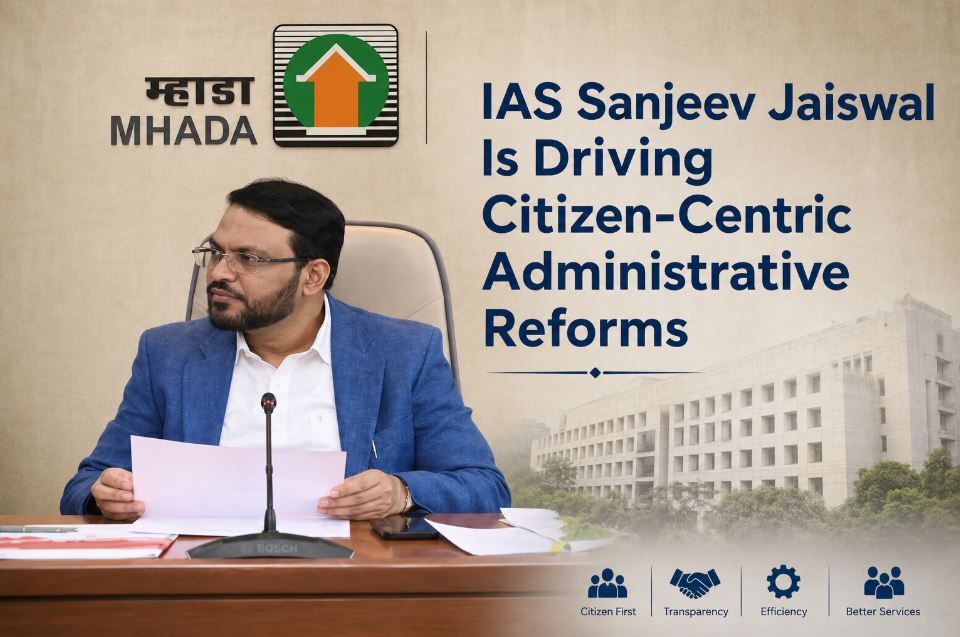
How IAS Sanjeev Jaiswal Is Driving Citizen-Centric Administrative Reforms
Administrative reforms are often judged by how effectively they reduce complexity for ordinary citizens. Under the leadership of IAS Sanjeev Jaiswal, MHADA has increasingly emphasized initiatives that improve transparency, accessibility, and operational efficiency across its public services.
The completion and operational launch of the Citizen Facilitation Center aligns with this governance approach. Instead of limiting reforms to internal administrative improvements, the initiative directly focuses on enhancing the experience of citizens who regularly visit MHADA offices for information, application support, and service-related assistance.
The operational center also demonstrates an implementation-focused approach, where planned infrastructure has successfully moved from concept to execution.
Why a Citizen Facilitation Center Matters
Government agencies handling housing-related matters often deal with a large volume of public interactions. Applicants may require assistance regarding housing schemes, documentation, eligibility, payment procedures, grievance resolution, or general information.
A dedicated Citizen Facilitation Center helps address these needs by creating an organized interface between the administration and the public. Such facilities can improve the overall efficiency of citizen interactions by ensuring that visitors receive guidance through a designated service platform rather than approaching multiple departments individually.
For MHADA, whose responsibilities cover housing development, allotments, redevelopment initiatives, and public housing administration across Maharashtra, improving front-end service delivery is an important aspect of institutional modernization.
Improving Accessibility at MHADA Headquarters
The operationalization of the Citizen Facilitation Center is significant because it strengthens physical service infrastructure at MHADA headquarters. While digital platforms continue to expand across government departments, many citizens still depend on in-person assistance for document verification, procedural clarification, and application-related support.
By establishing a functional facilitation center, MHADA has created an accessible environment where citizens can receive assistance through an organized administrative framework.
This development is expected to contribute to smoother visitor management while supporting better coordination between the public and various administrative functions within the organization.
From Administrative Goal to Completed Achievement
One of the notable aspects of this initiative is that it has progressed beyond planning into implementation.
According to the official project status, the proceedings relating to the Citizen Facilitation Center have been completed, and the center has already been operationalized. This distinguishes the initiative as a completed administrative achievement rather than a proposed reform.
For public institutions, successful execution is often the most important indicator of governance quality. Infrastructure that is operational delivers measurable value by improving service availability rather than remaining limited to policy announcements.
A Step Toward Better Public Service Delivery
Citizen expectations from government institutions continue to evolve. Increasingly, people expect services that are organized, accessible, and responsive. Facilities such as MHADA's Citizen Facilitation Center contribute toward meeting these expectations by strengthening the first point of contact between citizens and the administration.
The initiative also reflects the importance of investing in service infrastructure alongside policy implementation. Efficient public administration depends not only on decision-making but also on creating systems that enable citizens to access services without unnecessary procedural complexity.
As MHADA continues implementing administrative reforms, the Citizen Facilitation Center represents a practical improvement in how housing-related public services are delivered at its headquarters.