
Maharashtra
India Deploys Its Largest-Ever Rail TBMs for Mumbai-Ahmedabad Bullet Train Project - Here’s Why It’s a Major Engineering Milestone
Fri May 15 2026
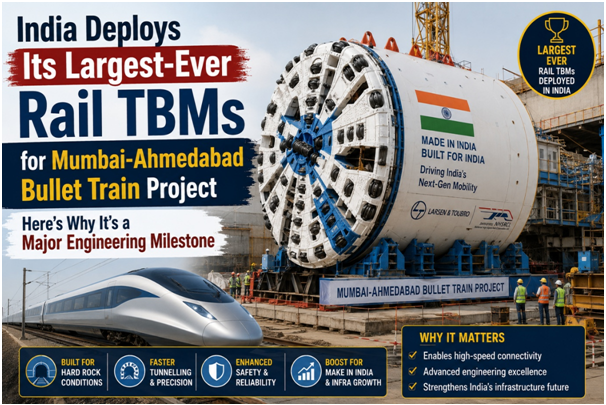
The Mumbai-Ahmedabad High-Speed Rail project has achieved a major engineering milestone with the deployment of India’s largest rail Tunnel Boring Machines (TBMs). A 350-tonne cutterhead was successfully lowered at Vikhroli, marking the start of large-scale underground tunnelling. The TBMs, each weighing over 3,000 tonnes and spanning 13.6 metres in diameter, will construct nearly 16 km of tunnel in Mumbai, including a 7-km undersea stretch beneath Thane Creek—India’s first undersea rail tunnel. Equipped with advanced excavation technology for complex urban conditions, the project reflects India’s growing engineering capabilities in high-speed rail infrastructure.
India’s ambitious Mumbai-Ahmedabad High-Speed Rail project has reached another major milestone with the deployment of the country’s largest tunnel boring machines (TBMs) for rail infrastructure development. The development marks a significant step in the construction of the underground section of the high-speed rail corridor, particularly in Mumbai’s complex urban terrain.
The latest progress highlights the scale of engineering, precision, and technological capability being deployed for one of India’s most advanced transportation infrastructure projects.
350-Tonne Cutterhead Lowered at Vikhroli
A major milestone was achieved at Vikhroli after a massive 350-tonne tunnel boring machine cutterhead was successfully lowered, marking the beginning of the underground tunnelling system assembly phase.
The cutterhead forms the front end of the TBM and plays a critical role in excavation operations. According to project details, the component was delivered in five separate consignments and assembled onsite using precision welding techniques.
The deployment signals the transition from preparation work to large-scale underground tunnel construction for the bullet train corridor.
Massive Engineering Scale Sets New Benchmark
The cutterhead itself measures 13.6 metres in diameter, showcasing the enormous scale of machinery being used for the project.
The Mumbai underground section spans nearly 21 kilometres, out of which approximately 16 kilometres will be constructed using two giant TBMs. Each machine weighs more than 3,000 tonnes and is designed to construct a single tunnel capable of carrying both up and down railway lines.
These TBMs are now the largest ever deployed in India for rail tunnel construction, setting a new benchmark for underground infrastructure capability in the country.
The project reflects how India’s infrastructure sector is increasingly adopting advanced engineering technologies for high-capacity transport systems.
India’s First Undersea Rail Tunnel
One of the most significant features of the Mumbai underground section is the planned 7-kilometre stretch beneath Thane Creek.
This section will become India’s first undersea rail tunnel, making it one of the most technically challenging segments of the entire high-speed rail corridor.
Constructing tunnels beneath water bodies and densely populated urban areas requires highly specialised engineering systems, advanced safety mechanisms, and continuous monitoring during excavation work.
The inclusion of an undersea rail tunnel represents a major leap forward in India’s transport infrastructure and tunnelling capabilities.
Advanced TBM Design for Complex Urban Excavation
The tunnel boring machines being deployed for the project are equipped with advanced excavation technology designed for both rock and soil conditions.
The cutterhead includes:
- 84 cutter discs
- 124 scrapers
- 16 bucket lips
These components are engineered to efficiently break through underground surfaces, remove excavated material, and guide the muck into the chamber pipeline system during tunnelling operations.
The design reflects the level of precision required for underground construction beneath one of India’s busiest metropolitan regions.
Excavation Route From Vikhroli to BKC
From Vikhroli, the TBM will excavate nearly 6 kilometres towards Bandra-Kurla Complex (BKC), one of Mumbai’s key commercial hubs.
The route will pass beneath densely populated urban zones as well as the Mithi River before the machine is eventually retrieved at the under-construction station complex site.
Executing underground tunnelling through such highly developed urban areas requires careful planning to minimise surface disruption while maintaining structural and operational safety throughout the excavation process.
A Landmark Moment for India’s Infrastructure Growth
The deployment of India’s largest rail TBMs represents more than just a construction milestone. It reflects the growing scale and sophistication of infrastructure development in the country.
From advanced underground tunnelling systems to India’s first undersea rail tunnel, the Mumbai-Ahmedabad bullet train project is introducing engineering capabilities that could shape future transport and urban infrastructure projects nationwide.
As work progresses on the high-speed corridor, the successful deployment of these giant TBMs highlights India’s increasing capacity to execute technologically complex and globally competitive infrastructure projects at scale.