
Maharashtra
India’s First Rapid Drug Screening Machines in Maharashtra
Thu Oct 29 2026
Maharashtra Becomes India’s First State to Deploy Drug Detection Machines That Screen Medicines in One Minute
Maharashtra has introduced advanced portable drug detection machines to strengthen medicine quality checks across government hospitals. The state has invested Rs 9.6 crore in 8 machines that can screen medicines in about one minute and identify samples that may require detailed laboratory testing. The government has also announced plans to recruit 3,300 doctors and healthcare personnel by the end of November 2026.
Maharashtra Invests Rs 9.6 Crore in Advanced Medicine Testing Technology
Maharashtra has become the first state in India to deploy portable drug detection machines based on Raman spectroscopy technology. The initiative aims to improve medicine quality monitoring and help protect patients receiving treatment at government hospitals and other public healthcare facilities.
The state government has purchased 8 machines at Rs 1.2 crore each, bringing the total investment to Rs 9.6 crore.
Public Health and Family Welfare Minister Prakash Abitkar launched the machines on Monday. He emphasized that checking the quality of medicines supplied to patients is an important responsibility of the public healthcare system.
The new technology will help officials quickly screen medicines, identify possible differences in their chemical composition, and send suspicious samples for further investigation.
How Do the New Drug Detection Machines Work?
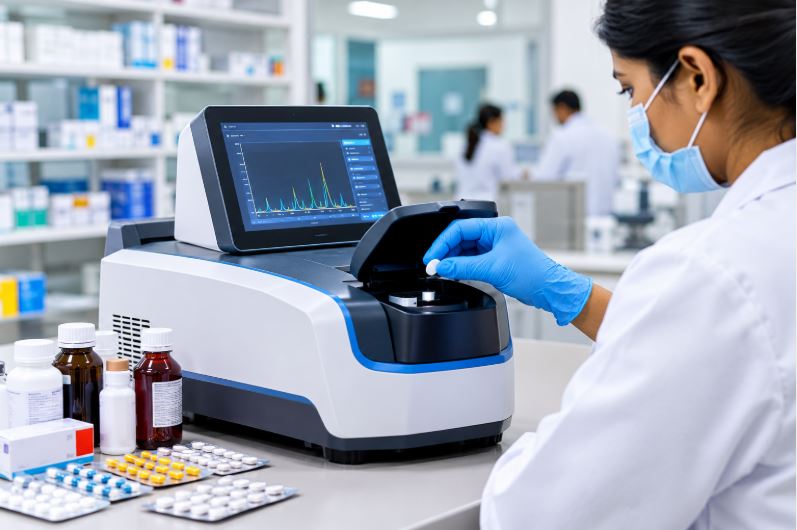
The machines use Raman spectroscopy, a technology that analyzes the chemical characteristics of a substance with the help of laser light. The resulting chemical fingerprint is compared with the expected composition of the medicine to identify possible differences.
Each machine has a database containing information on approximately 5,000 medicines. It can screen several types of pharmaceutical products, including:
- Tablets and capsules
- Liquid medicines
- Cough syrups
The screening process takes about one minute, allowing officials to check medicines more quickly during inspections.
However, the machines provide an initial screening result rather than a final confirmation of a medicine's quality. If a sample is flagged as suspicious, it will be sent to a laboratory accredited by the National Accreditation Board for Testing and Calibration Laboratories (NABL) for detailed testing.
Strict Action Planned Against Companies Supplying Defective Medicines
The Maharashtra government plans to take legal action against pharmaceutical companies if laboratory tests confirm quality problems in their products.
Depending on the findings and the seriousness of the violation, the authorities may initiate action under applicable laws. Companies involved in serious irregularities may also face blacklisting.
This approach is intended to strengthen accountability among medicine suppliers and improve the monitoring of pharmaceutical products purchased for government healthcare facilities.
By combining rapid screening with laboratory confirmation, officials will be able to identify suspicious samples earlier while ensuring that further action is based on reliable test results.
8 Machines Deployed Across Maharashtra
The Public Health Department has deployed the 8 machines in the following locations:
- Thane
- Pune
- Nagpur
- Solapur
- Kolhapur
- Chhatrapati Sambhajinagar
- Amravati
- Latur
The machines will support inspections at district hospitals, sub-district hospitals, rural hospitals, and other government healthcare institutions covered by the respective teams.
The department has trained 16 officials to operate the equipment, with two officials assigned to each machine, including a pharmacist. The equipment supplier will also provide maintenance and technical support.
In addition, the government has formed a flying squad to inspect medicines supplied to public hospitals and those administered to patients. These inspections are expected to help officials identify products that need further examination and strengthen quality monitoring across the state.
Maharashtra Plans to Recruit 3,300 Doctors and Healthcare Personnel
Along with improving medicine quality checks, the state government is working to address staff shortages in public hospitals.
Minister Prakash Abitkar announced plans to appoint 3,300 doctors and healthcare personnel by the end of November 2026.
The recruitment process is expected to take place in two phases.
First Phase: 1,400 Doctors
The first phase is scheduled for the first week of November. It will include:
- 600 specialist doctors
- 800 MBBS graduates
These appointments are expected to help government hospitals strengthen their medical teams and improve access to healthcare services.
Second Phase: 1,900 Community Health Officers
The second phase is expected to be completed by the end of November. It will involve 1,900 candidates with Bachelor of Ayurvedic Medicine and Surgery (BAMS) degrees, who are expected to be appointed as Community Health Officers.
The planned recruitment is aimed at addressing workforce shortages and supporting healthcare delivery across the state.
What This Initiative Means for Patients in Maharashtra
The introduction of portable drug detection machines marks an important step in Maharashtra's efforts to improve medicine quality monitoring in the public healthcare system.
Faster screening can help officials identify potentially suspicious medicines without waiting for every initial check to be completed through conventional laboratory testing. Confirmatory laboratory analysis will remain essential before suspected defects are established and further action is taken.
Combined with the planned recruitment of 3,300 doctors and healthcare personnel, the initiative focuses on two key priorities: improving the quality checks for medicines supplied to government hospitals and strengthening the workforce that provides medical care.
These measures are expected to support better monitoring, stronger supplier accountability, and improved public healthcare services across Maharashtra.