
Maharashtra
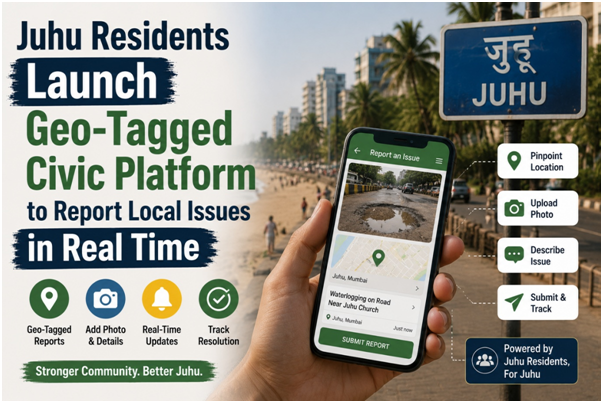
Juhu Residents Launch Geo-Tagged Civic Platform to Report Local Issues in Real Time
Sat May 16 2026
A volunteer network under the “Keep Juhu Clean” campaign has developed a geo-tagged digital platform allowing residents to report civic issues like garbage, water leaks, illegal hoardings, and tree cutting in real time. Complaints are registered with photographs, location details, and descriptions, creating a centralized database. Verified complaints are compiled into bi-weekly reports for BMC follow-up. The initiative enhances accountability, citizen participation, and organized documentation of local problems.
In an example of how community-led technology initiatives are reshaping urban civic engagement, residents of Juhu have developed a geo-tagged digital platform that allows citizens to report and document local civic problems in real time.
The initiative, created by a volunteer network under the “Keep Juhu Clean” campaign, functions as a centralised “issue collector” where residents can upload complaints related to sanitation, infrastructure, encroachments, pollution, and other neighbourhood concerns.
The platform reflects a growing trend in urban communities where citizens are increasingly using technology, data, and collective participation to improve accountability and streamline communication with civic authorities.
How the Geo-Tagged Civic Platform Works
The platform allows residents to report multiple types of civic issues across the locality. Complaints can include:
- Garbage and sanitation problems
- Illegal pavement encroachments
- Political hoardings
- Water leakages
- Tree hacking
- Air pollution caused by construction dust
To register a complaint, users are required to:
- Select the issue category
- Geo-tag their live location
- Upload photographs
- Briefly describe the problem
The geo-tagging feature automatically detects the latitude and longitude of the complaint location, helping volunteers and civic departments identify the exact site of the issue more efficiently.
By submitting complaints, residents also consent to their photographs and location details being used for the “Keep Juhu Clean” campaign and shared with volunteers or civic authorities for follow-up action.
Creating a Centralised Database of Civic Problems
According to Samarth Das, the platform has been operational for the last six months.
“While the resolution rate by authorities currently stands at under 10%, the initiative has at least succeeded in creating a centralised database of civic issues affecting the locality and placing them before the authorities in a structured manner,” Das said.
One of the key objectives of the platform is not only complaint collection but also systematic documentation. Once complaints are verified, they are compiled into bi-weekly reports and forwarded to the relevant civic departments.
The reports reportedly identify the assistant engineer or head of department responsible for addressing specific issues, helping residents track accountability within the civic system.
From Broken Roads to Illegal Hoardings
According to the reports reviewed by residents, the platform has documented a wide range of local civic concerns, including:
- Illegal political hoardings on light poles
- Garbage accumulation on road dividers
- Illegal fruit stalls
- Broken sidewalks
- Uneven roads
- Open gutters
The structured reporting mechanism allows residents to collectively present issues before authorities instead of relying solely on isolated complaints.
Community Participation Driving the Initiative
Rajat Mittal Shah, who helped build the platform, said the idea emerged from the increasing number of civic problems residents were observing across the area.
“One person alone cannot document everything. There was a strong need to systematically photo-document multiple civic issues, and that is how we decided to create a platform through which we could collectively approach the civic body,” he said.
Residents involved in the initiative are now exploring ways to make the system more sustainable and organised over the long term.
Another resident, Vikrant Chedda, highlighted the importance of consistent follow-up with authorities.
“While we are identifying and documenting the issues, it is ultimately up to the BMC to resolve them at the earliest,” he said.
“We are now exploring a system where specific volunteers are assigned individual complaints and continue following up until the issue is fully resolved.”
Technology and Civic Participation Are Reshaping Urban Governance
The Juhu initiative highlights how resident-led digital platforms are becoming increasingly important in urban governance and civic management.
By combining geo-tagging, photo documentation, volunteer coordination, and structured reporting, the platform is helping create a more organised channel between citizens and local authorities.
While the long-term effectiveness of such initiatives depends on sustained civic response and administrative action, the project demonstrates how technology-enabled citizen participation can strengthen local accountability and improve issue tracking at the neighbourhood level.
As cities continue to grow and civic challenges become more complex, community-driven digital initiatives like this may increasingly play a larger role in shaping cleaner, more responsive urban environments.