
Maharashtra
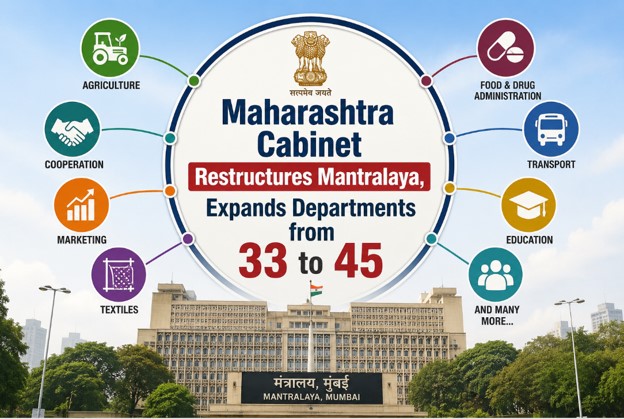
Maharashtra Cabinet Restructures Mantralaya, Expands Departments from 33 to 45
Wed Jun 10 2026
Through these reforms, the Maharashtra government aims to create a more efficient administrative structure, improve service delivery and strengthen long-term economic and infrastructure growth across the state.
Major Administrative Overhaul Approved to Improve Governance and Faster Decision-Making
In a major administrative reform, the Maharashtra Cabinet led by Chief Minister Devendra Fadnavis has approved a large-scale restructuring of Mantralaya departments. The move aims to make governance more efficient, improve coordination and speed up policy implementation across the state.
As part of the decision, the number of departments in the state secretariat will increase from 33 to 45.
Mantralaya Departments Increased from 33 to 45
The state government said the restructuring is designed to strengthen administration and make government systems more responsive under its Ease of Doing Business and Ease of Living vision.
At present, many departments manage multiple divisions under one setup, which often creates delays and coordination issues. With the new structure, major divisions will function as separate departments with independent administrative support, registration and finance systems.
Officials believe this change will improve execution of development projects and public welfare schemes.
Importantly, the government clarified that no new government posts will be created. Existing sanctioned and vacant positions will be redistributed among the newly created departments.
Agriculture, Cooperation and Other Departments to Function Separately
Several departments will now work independently to improve focus and administration.
Key changes include:
- Agriculture and Horticulture to become separate departments
- Cooperation, Marketing and Textiles to function independently
- Separate departments for Protocol, Transport and Energy
- Independent departments for Labour, Revenue, Relief and Rehabilitation
- Forest, School Education, Sports, Tourism and Cultural Affairs to operate separately
- Dedicated Food and Drug Administration (FDA) department to be created from the Medical Education and Drugs Department
In another change, the Employment Guarantee Scheme division under the Planning Department will be merged with the Soil and Water Conservation Department.
Maharashtra Cabinet Approves Changes in Higher Education Rules
The Cabinet also approved amendments to the Maharashtra Public Universities Act, 2016.
The revised rules will allow final approvals for new colleges and expansion proposals for the academic year 2026–27.
The changes are expected to support:
- Introduction of new courses and subjects
- Expansion of academic divisions
- Creation of new educational facilities
The government has extended the deadline for granting approvals to new colleges and campuses till June 30, 2026.
These provisions will also apply to Kavikulaguru Kalidas Sanskrit University in Ramtek.
Maharashtra GST Act to Match Central GST Rules
The Cabinet approved amendments to the Maharashtra Goods and Services Tax (GST) Act, 2017.
The decision aims to align state GST laws with the latest changes introduced under the Central GST Act following recommendations made during the 56th GST Council meeting.
According to the government, the update will help maintain legal consistency and support smoother GST implementation across Maharashtra.
MIDC Gets Higher Borrowing Powers for Infrastructure Growth
In another major decision, the Cabinet approved amendments to the Maharashtra Industrial Development Act, 1961.
The change will allow the Maharashtra Industrial Development Corporation (MIDC) to increase its borrowing capacity for industrial and infrastructure development.
The government has already approved a ₹6,000 crore HUDCO loan for land acquisition linked to the proposed Purandar Airport project.
Officials said the higher borrowing limit will help fund land acquisition, support farmer compensation and accelerate industrial zone and infrastructure development across Maharashtra.