
Maharashtra
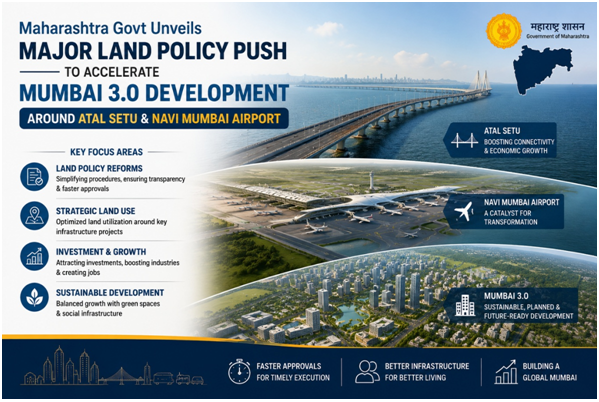
Maharashtra Govt Unveils Major Land Policy Push to Accelerate Mumbai 3.0 Development Around Atal Setu & Navi Mumbai Airport
Thu May 21 2026
The Maharashtra government has launched a comprehensive Land Acquisition and Allotment Policy for the Mumbai 3.0 region near Atal Setu and Navi Mumbai Airport. The policy introduces incentives for investors, multiple compensation models for landowners, and reforms to attract high-value industries such as IT, logistics, and data centres. The MMRDA has been appointed as the New Town Development Authority, covering 323.44 sq km and 124 villages. Special provisions, including SPVs for Growth Centres and a high-level dispute resolution committee, aim to accelerate industrial and urban development while ensuring fair rehabilitation.
The Maharashtra government has taken a major step towards accelerating the development of Mumbai 3.0 by introducing a comprehensive Land Acquisition and Allotment Policy focused on the region surrounding the Atal Bihari Vajpayee Sewri-Nhava Sheva Atal Setu (MTHL) and the Navi Mumbai International Airport. The new policy introduces multiple incentives, compensation models and investment-focused reforms aimed at transforming the region into a major economic and infrastructure hub.
The ambitious Mumbai 3.0 vision is now gaining strong momentum under the leadership of Maharashtra Chief Minister Devendra Fadnavis, with the state government aggressively pushing large-scale urban expansion beyond Mumbai’s existing city limits. Through new industrial policies, land reforms and infrastructure planning around the Atal Setu and Navi Mumbai Airport corridor, the government is positioning Mumbai 3.0 as one of Maharashtra’s biggest long-term economic growth and urban development initiatives.
MMRDA Appointed as New Town Development Authority
In a Government Resolution (GR) issued by the Urban Development Department, the Maharashtra government has officially designated the Mumbai Metropolitan Region Development Authority (MMRDA) as the New Town Development Authority (NTDA) for the proposed Mumbai 3.0 region.
The authority will oversee development across approximately 323.44 square kilometres covering 124 villages spread across the Uran, Panvel and Pen talukas of Raigad district.
However, forest lands, Coastal Regulation Zone (CRZ) areas and a 250-metre buffer zone around the Pen Municipal Council limits have been excluded from the jurisdiction of the authority.
The move gives MMRDA expanded powers to plan and execute large-scale urban infrastructure and industrial development projects in the region.
Mumbai 3.0 to Focus on High-Value Industries
The Mumbai 3.0 concept was formally highlighted by Chief Minister Devendra Fadnavis during his budget speech on March 6 after the state cabinet approved the proposal on February 10.
The government aims to develop the region as a modern economic growth corridor capable of attracting non-polluting and high-value industries including data centres, Information Technology (IT), IT-enabled services (ITeS) and logistics hubs.
The state government has also clarified that the policy has been designed in a manner that will not impose any direct or indirect financial burden on the state treasury.
New Compensation and Rehabilitation Models Introduced
One of the most important features of the new policy is the introduction of multiple compensation and rehabilitation models for landowners and farmers.
Under the policy, private landowners surrendering land through negotiations will receive 22.5% of the developed land back under the CIDCO model. Landowners eligible for less than 40 square metres of developed land will instead receive direct cash compensation.
The policy also allows land acquisition through Floor Space Index (FSI) or Transferable Development Rights (TDR).
In cases where landowners do not consent to negotiated settlements, the government may proceed with compulsory acquisition under the Right to Fair Compensation and Transparency in Land Acquisition, Rehabilitation and Resettlement Act, 2013.
The compensation framework is aimed at balancing infrastructure expansion with rehabilitation and financial protection for affected landowners.
Maharashtra Targets Large Investors Through New Incentives
The Mumbai 3.0 policy also introduces several investor-friendly measures inspired by the Maharashtra Industrial Development Corporation (MIDC) model.
According to the policy, investors bringing Foreign Direct Investment (FDI) will receive priority in land allotment. Eligible investors must acquire at least 100 acres and commit a minimum investment of ₹250 crore per 100 acres within four years.
The state has also approved a “Pass-Through” policy aimed at accelerating industrialisation in undeveloped regions. Under this model, land will be allotted on an “as-is-where-is” basis, while infrastructure and acquisition costs will be recovered from allottees in instalments.
Officials believe the new framework can accelerate industrial development while reducing upfront financial pressure on government agencies.
MMRDA Allowed to Create Growth Centres
The policy further allows MMRDA to collaborate with land aggregators through Expressions of Interest (EOI) for forming Special Purpose Vehicles (SPVs).
These SPVs will be used to develop specialised “Growth Centres” within the Mumbai 3.0 region. Officials believe the model can improve land pooling, attract faster investments and support integrated urban development.
The state government has also directed MMRDA to create a robust revenue generation framework to maximise long-term returns from infrastructure investments in the region.
High-Level Committee Formed for Dispute Resolution
To ensure smoother implementation of the policy, the Maharashtra government has constituted a high-level committee headed by the Additional Chief Secretary of the Urban Development Department.
The committee will focus on resolving disputes between landowners and authorities during land acquisition and implementation stages.
Officials believe this mechanism will help accelerate project execution while reducing administrative and legal delays.
Mumbai 3.0 Emerging as Maharashtra’s Biggest Urban Expansion Vision
With strategic connectivity through the Atal Setu, proximity to the Navi Mumbai International Airport and a large development zone spanning over 323 square kilometres, Mumbai 3.0 is rapidly emerging as one of Maharashtra’s most ambitious urban expansion and economic development projects.
The combination of infrastructure growth, industrial investment, land pooling reforms and long-term planning indicates the state government’s intention to build a major new urban and economic corridor connected to the Mumbai Metropolitan Region.Top of Form