
Maharashtra
Maharashtra Housing Redevelopment Rules 2026 Simplified
Wed Jul 22 2026
New Redevelopment Rules Bring Digital Meetings and Faster Decision-Making for Housing Societies
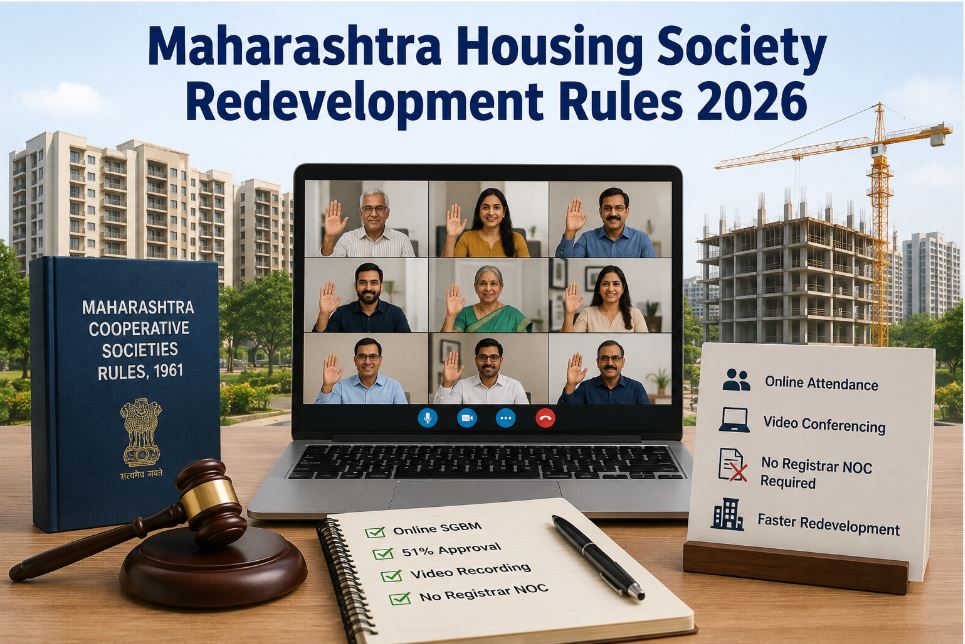
Maharashtra has introduced important changes to its cooperative housing society redevelopment rules, making the redevelopment process more flexible and technology-friendly. The amendments to the Maharashtra Cooperative Societies Rules, 1961, officially notified on June 18, now allow society members to participate in redevelopment Special General Body Meetings (SGBMs) through video conferencing.
The updated rules also remove the long-debated requirement of obtaining a No Objection Certificate (NOC) from the Registrar before selecting a redevelopment developer. However, legal experts believe certain provisions related to meeting quorum may create confusion and could result in redevelopment disputes unless clarified by the state government.
Housing Society Members Can Now Join Redevelopment Meetings Online
One of the biggest reforms introduced under Rule 106C-13(3)(j) is the permission for members to attend redevelopment SGBMs virtually through video conferencing.
This change is expected to benefit thousands of housing societies across Maharashtra, especially in Mumbai, Thane, Pune, Navi Mumbai, and other cities where many members live outside the society premises or even overseas.
Earlier, physical attendance often made it difficult for societies to achieve the required participation. By recognizing online attendance, the government aims to make redevelopment decisions easier and more inclusive.
Developer Selection Still Requires Support From 51% of Total Members
Although members can now participate digitally, the voting requirement remains unchanged.
Under the amended rules, the resolution to appoint a redevelopment developer or contractor must receive approval from at least 51% of the society's total members. Members attending through video conferencing will also be counted while calculating this majority.
This provision is expected to reduce delays caused by low physical attendance during crucial redevelopment meetings.
Registrar's Representative Must Still Attend the Meeting
While the requirement for a Registrar's NOC has been removed, another important safeguard remains in place.
The rules continue to require the presence of an authorized representative from the Registrar's office during the Special General Body Meeting where the redevelopment developer is selected.
The Registrar's representative is responsible for observing the proceedings and preparing a factual report about the meeting. This report is then submitted to the Registrar, who communicates it to the housing society.
The representative's role is limited to recording the meeting process and does not include approving or rejecting the society's redevelopment decision.
Video Recording of Redevelopment Meetings Is Now Mandatory
The amended rules also make video recording compulsory for redevelopment SGBMs.
The recording must remain in the custody of the meeting chairman, while an additional copy must be submitted to the office of the Assistant or Deputy Registrar having jurisdiction over the housing society.
This requirement is intended to improve transparency and provide official documentation if disputes arise later.
Registrar's NOC Is No Longer Needed
One of the most significant changes is the removal of the Registrar's NOC requirement for developer selection.
The revised provisions clearly state that after the meeting, the Registrar's representative only needs to submit a factual report. The Registrar is required to communicate that report to the society, but no approval, clearance, or NOC is necessary before appointing a redevelopment developer.
Experts believe this amendment will simplify redevelopment procedures and reduce administrative delays that housing societies previously faced.
Quorum Rules May Create Legal Confusion
Despite the reforms, legal experts have pointed out that the amended rules contain conflicting provisions regarding meeting quorum.
Rule 106C-13(3)(i) requires two-thirds of the society's total members to be present before a redevelopment SGBM can officially begin.
However, another provision allows an adjourned meeting to continue even if the required quorum is not available. At the same time, Rule 106C-13(3)(j) still requires approval from 51% of the total membership for selecting the redevelopment developer.
According to legal experts, these provisions may be interpreted differently by societies and developers, potentially leading to redevelopment-related litigation.
Experts Seek Further Clarification From Government
Legal experts have suggested that the Maharashtra government should issue additional clarification to avoid future disputes.
They recommend clearly specifying whether the two-thirds quorum should remain compulsory even for adjourned redevelopment meetings.
Experts have also pointed out that the wording of the amended rules may unintentionally suggest that every redevelopment-related Special General Body Meeting—including those for appointing a Project Management Consultant (PMC) or approving the Development Agreement (DA)—must also be held in the presence of the Registrar's representative.
They believe further clarification would help housing societies complete redevelopment projects more smoothly while reducing the chances of legal challenges.
What These New Rules Mean for Housing Societies
The latest amendments represent another step toward modernizing Maharashtra's housing society redevelopment process. Allowing virtual participation is expected to improve member involvement, especially in large societies where achieving physical attendance has often been difficult.
Removing the Registrar's NOC requirement should also speed up developer appointments and reduce procedural delays.
However, unless the state government clarifies the quorum provisions, housing societies may continue facing legal uncertainty during redevelopment decisions. Clear implementation guidelines could help ensure that the new rules deliver faster, more transparent, and dispute-free redevelopment across Maharashtra.