
MHADA
MHADA Cracks Down on Unsafe Homes
Thu Jun 25 2026
As Monsoon Risks Rise, Authorities Push for Evacuation While Residents Demand Clarity on Their Future
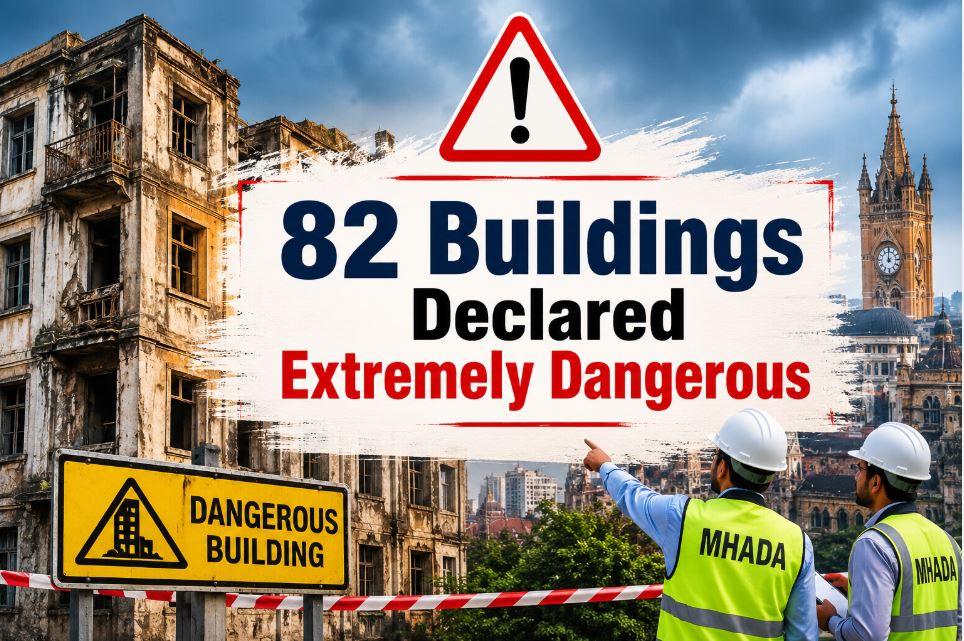
Mumbai’s annual monsoon preparedness exercise has once again exposed a long-standing urban challenge: the widening gap between public safety and housing security. This year, a pre-monsoon survey conducted by the Mumbai Building Repair and Reconstruction Board of MHADA identified 82 cessed buildings in South Mumbai as extremely dangerous, prompting authorities to initiate urgent evacuation measures. However, the issue has now entered a critical phase as thousands of residents continue to resist relocation despite repeated notices.
The situation has gained further urgency following directions from IAS Sanjeev Jaiswal, Vice Chairman and Chief Executive Officer of MHADA, who instructed officials to take concrete measures to protect residents living in highly dangerous structures. With heavy rainfall expected to intensify, MHADA has decided to seek disconnection of electricity and water supply to these buildings and proceed with evacuations under police protection if necessary. The decision reflects the growing concern that delaying action could lead to avoidable tragedies during the monsoon season.
Highlight: MHADA’s latest action underscores a difficult reality—when buildings become structurally unsafe, the challenge is no longer just redevelopment but balancing immediate safety with long-term housing certainty.
82 Buildings Declared Extremely Dangerous in South Mumbai
According to MHADA’s annual pre-monsoon assessment, 82 cessed buildings in South Mumbai have been categorized as extremely dangerous. Of these, 43 buildings were already part of last year’s dangerous structures list, highlighting the persistent nature of the problem.
Currently, 2,102 residents continue to occupy these buildings despite notices directing them to vacate. Under established procedures, occupants of highly dangerous buildings are usually shifted to transit accommodation so that lives are not put at risk during periods of heavy rainfall.
The concern is especially significant because many of these structures are old cessed buildings that have deteriorated over decades. Once a building reaches a stage where repairs are no longer viable, evacuation becomes a safety requirement rather than an administrative choice.
Why MHADA Is Taking Stronger Action This Year
The timing of the decision is closely linked to Mumbai’s monsoon cycle. Heavy rainfall has historically increased the risk of structural failures in aging buildings, particularly those already identified as beyond repair.
Officials from the Repair and Reconstruction Board have stated that the identified buildings are no longer capable of being safely occupied. As a result, MHADA has written to BEST and the Brihanmumbai Municipal Corporation requesting the disconnection of electricity and water services to the affected buildings.
The strategy reflects a shift from persuasion to enforcement. Authorities believe that continued occupancy of these structures could result in accidents, injuries, or fatalities if a collapse occurs during intense rainfall.
From a governance perspective, the move demonstrates a growing emphasis on preventive action. Urban administrators are increasingly being judged not only by how they respond to disasters but by how effectively they prevent them.
The Larger Challenge of Mumbai’s Aging Building Stock
The issue extends far beyond the 82 buildings currently identified as highly dangerous.
South Mumbai alone has approximately 14,000 cessed buildings, many of which are decades old and require continuous monitoring. Every monsoon season raises concerns about structural stability, making annual inspections a critical component of city safety planning.
The recurring appearance of 43 buildings on consecutive dangerous lists highlights a deeper structural challenge. Identifying unsafe buildings is only the first step; ensuring timely redevelopment, rehabilitation, and resident relocation remains the more difficult task.
This creates a cycle where authorities face pressure to protect lives, while residents seek guarantees about their future housing security before agreeing to move.
Why Residents Are Refusing to Vacate
Despite the safety concerns, many residents have firmly opposed evacuation.
Their objections are rooted less in the danger assessment and more in uncertainty about what happens after they leave. Residents argue that they are being offered temporary transit accommodation without clear assurances regarding permanent housing or redevelopment timelines.
Mukesh Shah-Pendse, President of Pagdi Ekta Sangh, has highlighted several concerns raised by occupants. One major issue is the limited availability of transit accommodation. While more than 2,000 residents are affected, MHADA reportedly has only 750 transit camp units available.
Residents also question the policy framework for those who may not receive transit accommodation and instead require rental support. According to their concerns, there is insufficient clarity regarding compensation mechanisms and timelines for returning to redeveloped homes.
For families who have lived in these neighborhoods for generations, relocation is not merely a temporary shift in address. It often involves disruption of livelihoods, social networks, schools, and daily routines.
Safety Versus Housing Security: A Policy Dilemma
The current standoff highlights one of Mumbai’s most complex urban governance challenges.
On one side is the undeniable need to prevent loss of life. If authorities have identified buildings as structurally unsafe and beyond repair, allowing continued occupation carries significant risk. Any collapse could have devastating consequences for residents and emergency responders alike.
On the other side are legitimate concerns about rehabilitation and redevelopment certainty. Residents want assurances that temporary relocation will not become an indefinite displacement.
This tension reveals an important lesson for urban policy. Safety directives are most effective when accompanied by transparent rehabilitation plans, clear timelines, and adequate transit housing capacity. Without these elements, resistance from affected communities becomes almost inevitable.
What Happens Next?
MHADA officials have indicated that action to disconnect utilities and enforce evacuation could begin soon. Letters requesting suspension of electricity and water services have already been sent to the relevant agencies.
As monsoon conditions intensify, the window for voluntary relocation is narrowing. Authorities are expected to continue efforts to move residents out of the identified buildings before heavy rainfall increases the risk of structural failures.
The outcome of this confrontation may also influence how future dangerous-building evacuations are handled across Mumbai. It raises important questions about transit housing availability, redevelopment accountability, and the balance between enforcement and public trust.
Conclusion
The situation surrounding South Mumbai’s 82 extremely dangerous cessed buildings is not merely a monsoon preparedness story. It is a reflection of the broader challenges facing an aging city where infrastructure, housing, and safety concerns intersect.
MHADA’s decision to seek disconnection of electricity and water supply signals the seriousness of the threat perceived by authorities. Yet the resistance from 2,102 residents illustrates that safety measures alone cannot resolve long-standing housing anxieties.
Ultimately, protecting lives remains the immediate priority. But lasting solutions will depend on creating a rehabilitation framework that gives residents confidence that evacuation is not the end of their housing journey, but the beginning of a safer and more secure future.