
MHADA
MHADA Housing Update: Strict Action Against Developers Ordered
Fri Aug 07 2026
Mangalprabhat Lodha Told to Take Strict Action Against Developers Holding Back Reserved Homes
Maharashtra Housing and Area Development Authority (MHADA) has been urged to take firm action against developers who fail to hand over homes reserved for the authority. Maharashtra Minister for Skills, Employment, Entrepreneurship and Innovation and Joint Guardian Minister of Mumbai Suburban, Mangalprabhat Lodha, said that simply filing police complaints is not enough when developers delay the transfer of MHADA homes.
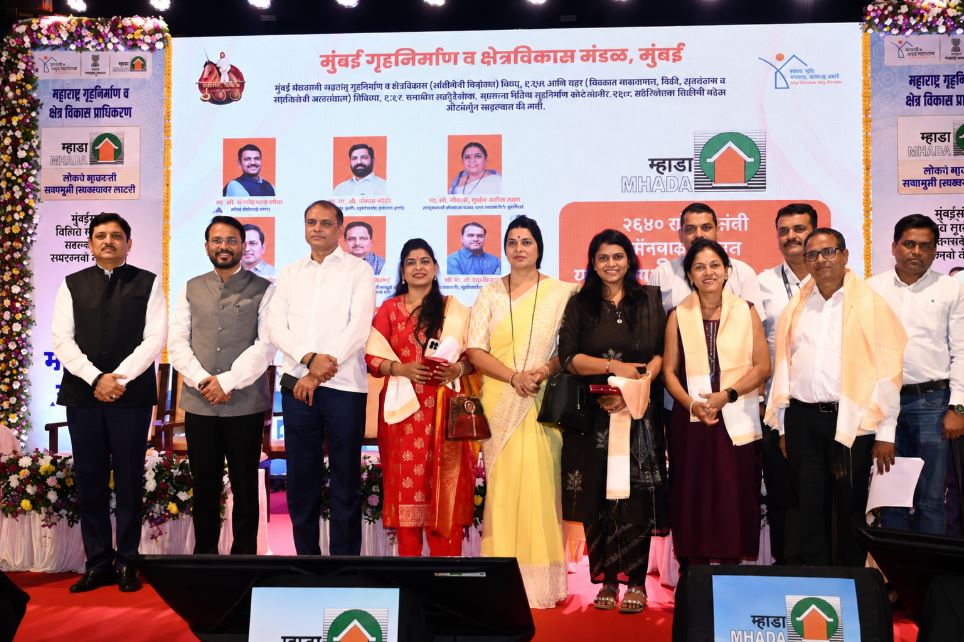
Lodha made the remarks during a computerized lottery for 2,640 MHADA homes held at Rangsharda Auditorium in Bandra West, Mumbai. The event highlighted the growing demand for affordable housing in the city and the need for stronger enforcement of housing rules.
The event was attended by Minister of State for Housing Pankaj Bhoyar, Mumbai Mayor Ritu Tawde, MHADA Vice Chairman and CEO Sanjeev Jaiswal, Mumbai Board Chief Officer Milind Borikar, Mumbai Building Repair and Reconstruction Board Chief Officer Milind Shambharkar, Deputy CEO Anil Wankhade and other senior officials.
Developers Must Hand Over MHADA Reserved Homes
Lodha said developers who receive additional development rights are required to hand over designated homes to MHADA. However, in several cases, these homes are reportedly not transferred for years.
Such delays reduce the number of affordable homes available to ordinary citizens and slow down the housing process.
Lodha called for strict enforcement against developers who fail to follow the rules. He said authorities should go beyond filing FIRs and take strong action against those responsible, including legal action where necessary.
According to Lodha, action against even a few defaulters could send a strong message to the wider development community. He said this could help MHADA receive at least 1,000 additional reserved homes quickly, allowing more families to benefit from affordable housing.
Advisory Committees Proposed to Improve MHADA Services
Lodha also suggested creating advisory committees within MHADA to strengthen communication between citizens and the housing authority.
He pointed to a similar citizen participation model associated with Chief Minister Devendra Fadnavis and said MHADA could adopt a comparable approach.
The proposed committees could include local public representatives, housing experts, architects, nonprofit organization representatives and professionals working in related fields.
Such committees could provide a direct channel for residents to raise local concerns, discuss housing-related issues and help the administration respond more quickly.
Lodha said better communication between citizens and MHADA could make housing services more responsive and improve the resolution of problems at the local level.
75,127 Applications Received for 2,640 MHADA Homes
The strong response to the latest MHADA lottery reflects the continuing demand for affordable housing in Mumbai.
The computerized draw offered 2,640 homes under different housing schemes. MHADA received 75,127 applications, resulting in an average of 28.54 applications for every available home.
Pankaj Bhoyar said the high number of applications demonstrates the strong demand for reasonably priced housing in Mumbai. He also highlighted the importance of MHADA's computerized lottery system, which is designed to operate transparently and without direct human intervention.
For thousands of Mumbai residents, owning a home remains a major aspiration, particularly as housing costs continue to make private homes difficult to afford.
MHADA Expands Housing Construction Across Maharashtra
Bhoyar said MHADA has continued to work on housing projects across Maharashtra while the state government focuses on improving living conditions for residents.
He also highlighted group redevelopment initiatives being undertaken under the guidance of the state leadership. The broader objective is to increase housing supply while supporting redevelopment in established urban areas.
The BDD Chawl Redevelopment Project was also highlighted during the event. Mumbai Mayor Ritu Tawde said residents have received 500-square-foot homes with modern amenities at no cost under the redevelopment initiative.
She said the project represents an important step toward helping existing Mumbai residents continue living in the city while gaining access to improved housing.
MHADA Targets More Than 7.5 Lakh Homes
MHADA Vice Chairman and CEO Sanjeev Jaiswal outlined the authority's broader housing plans and said the latest draw was conducted in line with directions to organize at least one housing lottery every year.
Jaiswal noted that MHADA's various divisional boards have conducted around 25 lotteries during the past three years, making approximately 50,000 homes available to applicants.
He also discussed the larger housing target for the Mumbai Metropolitan Region. With the region being developed as a Growth Hub, the overall target is 30 lakh homes. Of these, 22 lakh homes are expected to come through slum redevelopment under the Slum Rehabilitation Authority, while 8 lakh homes are planned through MHADA and other agencies.
MHADA itself has taken responsibility for more than 7.5 lakh homes as part of this broader housing goal.
New Housing Policy Looks Beyond Traditional Homes
Jaiswal said MHADA's housing strategy is also expanding beyond conventional residential units.
The new housing policy includes provisions for working women's hostels, old-age homes, student hostels and housing for industrial workers. Rental housing has also emerged as an important priority for Mumbai.
To support this need, MHADA is preparing a rental housing portal, according to Jaiswal.
The authority is also planning housing development through cluster redevelopment on around 925 acres of land over the next seven years. The project is expected to rehabilitate approximately 65,000 people.
Under the cluster model, MHADA could receive around 30,000 homes, while developers could receive about 1 lakh homes. Jaiswal also noted that policy changes related to the 20 percent comprehensive plan may be required to support the redevelopment process.
PMAY Continues to Support Affordable Urban Housing
Jaiswal also highlighted the progress of the Pradhan Mantri Awas Yojana (Urban) in Maharashtra.
During the first phase of PMAY-Urban, around four lakh homes were constructed in urban areas of the state. In addition, around six lakh homes were supported through the Credit Linked Subsidy Scheme, which provided housing finance assistance through banking institutions.
Under PMAY 2.0, approximately two lakh homes have so far been sanctioned through components including Beneficiary-Led Construction and other housing programs.
These initiatives are aimed at expanding access to affordable housing and reducing homelessness across urban areas.
More Mumbai Board Homes Expected in 2027
Jaiswal also said MHADA's Mumbai Board flats are expected to be announced for sale in January or February 2027.
The announcement could provide another major opportunity for Mumbai residents looking for affordable housing through MHADA's housing programs.
The latest lottery and upcoming projects show that demand remains far higher than the current supply of affordable homes. This makes timely construction, transparent allocation and strict enforcement against rule violations increasingly important.
MHADA Lottery Draw Attracts Thousands Online
The latest MHADA draw was also streamed live through the authority's official YouTube channel and Facebook page, allowing applicants and members of the public to watch the process remotely.
Around 95,000 people watched the draw on YouTube, while approximately 13,000 viewers followed it on Facebook.
The strong digital audience, combined with more than 75,000 applications for 2,640 homes, underlines the scale of Mumbai's affordable housing challenge.
For MHADA, the next phase will be about converting ambitious housing targets into actual homes, ensuring reserved units reach the authority on time, and making the system easier for citizens to access. Stronger enforcement and greater public participation, as proposed by Lodha, could play an important role in making that process more effective.