
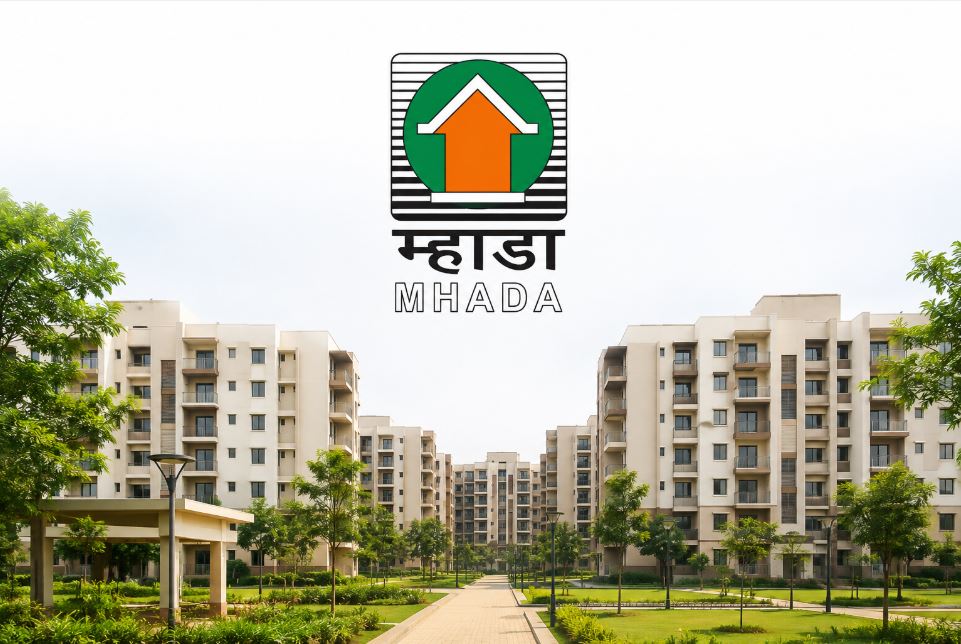
MHADA
MHADA Nashik Land Deal Boosts Affordable Housing Plans
Sat Aug 01 2026
Affordable housing is often discussed in terms of policies and promises, but real progress begins when land-the most critical and expensive ingredient in housing development-becomes available. In Nashik, the Maharashtra Housing and Area Development Authority (MHADA) has taken an important step in that direction after receiving three surplus land parcels in Makhmalabad from the district administration. The transfer, covering 2,553 square meters, lays the foundation for a new affordable housing project expected to benefit nearly 200 lower-income families while reinforcing the importance of strategic land management in urban development.
Under the leadership of IAS Sanjeev Jaiswal, Vice President and CEO of MHADA, the authority has consistently focused on expanding the pipeline of affordable housing opportunities through better planning, efficient land utilization, and timely project execution. The latest land transfer in Nashik reflects this broader institutional approach, where unlocking government-owned land is viewed as a practical solution to increasing housing availability for economically weaker and lower-income sections. Rather than merely adding another project to its portfolio, MHADA is strengthening its long-term capacity to create sustainable housing supply in growing urban centers.
Highlight: Affordable housing succeeds when public land moves from idle records to active construction, turning policy intent into real homes for deserving families.
Makhmalabad Land Transfer Opens New Opportunities for Affordable Housing
The Nashik district administration has formally transferred three surplus land parcels in Makhmalabad to MHADA's Nashik division after declaring the land surplus under the Urban Land Ceiling (ULC) Act, 1976. The total land area measures 2,553 square meters and has been transferred at a nominal rate of Re 1 per square meter, making the total transaction value just Rs 2,553.
Although the financial value of the transfer is symbolic, its development potential is significant. Land acquisition is typically among the largest cost components in housing projects. By transferring government-owned surplus land at a nominal price, authorities substantially reduce project costs, allowing greater focus on affordable housing construction rather than expensive land procurement.
The approval was issued by Nashik Collector and Competent Authority Ayush Prasad following recommendations made during a technical committee meeting that reviewed proposals concerning vacant government land.
Why Government Land Transfers Matter More Than Ever
Urban housing challenges are rarely caused by construction capability alone. More often, they stem from the shortage of developable land within expanding cities. Government agencies frequently possess unused or surplus land that remains underutilized for years.
The transfer of these three parcels demonstrates how coordinated action between district administration and housing authorities can unlock dormant public assets. Instead of remaining idle, the land will now contribute directly to addressing housing demand among lower-income groups.
This approach also improves public asset utilization without requiring expensive market purchases. It represents a governance model where administrative coordination becomes as valuable as financial investment.
Housing Potential: Around 170 Homes Planned
According to a senior MHADA official, the available land is expected to accommodate approximately 170 dwelling units. These homes are likely to include residential units measuring around 40 square meters and 50 square meters.
While the final project design is still under preparation, the authority expects the development to benefit nearly 200 lower-income families. The exact number of units will be finalized after detailed planning, architectural design, and statutory approvals.
The focus on compact yet practical home sizes aligns with the objective of serving lower-income households while maximizing efficient use of available urban land.
Strict Development Conditions Ensure Responsible Urban Planning
The land transfer is accompanied by several important conditions designed to ensure that development proceeds responsibly.
MHADA has been instructed to commence and utilize the land for its designated housing project within three years of taking possession. This condition prevents valuable public land from remaining undeveloped after transfer.
The authority is also prohibited from selling, gifting, mortgaging, or subdividing the land without obtaining prior approval from the State Revenue Department. Such restrictions help preserve the land exclusively for its intended public housing purpose.
Infrastructure and environmental responsibilities have also been incorporated into the approval. The project must provide a minimum 12-metre-wide access road, comply with all applicable statutory building regulations, and maintain green cover by planting one tree for every 100 square meters of open space.
These conditions indicate that affordable housing is increasingly being planned alongside environmental sustainability and urban infrastructure rather than as standalone residential construction.
Administrative Readiness Speeds Up Project Execution
Before approving the transfer, MHADA completed the required payments into the government treasury under the specified accounting head. Official measurement maps were verified by the Deputy Superintendent of Land Records, ensuring legal and technical accuracy before possession.
The land has been granted under Category Class-II occupancy rights, providing a clear legal framework for development.
Additionally, the Nashik Collector has instructed the Naib Tehsildar to complete the formal handover process, obtain a compliance undertaking from MHADA, and update the 7/12 land records accordingly.
Such procedural clarity reduces future administrative uncertainty and enables construction activities to begin with stronger legal backing.
Strong Demand Makes Makhmalabad a Strategic Choice
According to MHADA officials, housing projects in the Makhmalabad area continue to witness strong public demand. This makes the newly transferred land strategically valuable, as future housing units are expected to serve an already established demand rather than creating supply in an underdeveloped location.
The authority has indicated that work on the new housing scheme is expected to begin shortly after planning activities are completed.
For prospective homebuyers from lower-income groups, this improves confidence that the project is progressing from land acquisition toward actual implementation.
A Small Land Transfer with Long-Term Urban Impact
At first glance, 2,553 square metres may appear modest compared to large township developments. However, urban housing solutions are increasingly being built through multiple well-located projects rather than a handful of mega developments.
The transfer illustrates how surplus government land can become a catalyst for expanding affordable housing without placing additional financial burden on the public exchequer. By combining efficient land utilization, administrative coordination, legal compliance, and targeted housing development, MHADA is creating a replicable model that other districts can potentially adopt.
For Nashik, the project promises new housing opportunities for nearly 200 families. More importantly, it demonstrates that affordable housing is not simply about constructing buildings-it begins with making land available in the right locations, under the right conditions, and with a clear commitment to timely execution. As MHADA advances planning for approximately 170 homes in Makhmalabad, this land transfer represents a practical example of how coordinated governance can translate public resources into lasting social infrastructure.