
MHADA
MHADA Starts Statewide Green Drive to Plant 100,000 Trees
Mon Jun 15 2026
MHADA announces a large-scale tree plantation and conservation drive aiming to plant one lakh trees and support environmental sustainability.
Green Initiative Aims to Expand Urban Forests, Protect Biodiversity, and Increase Community Participation
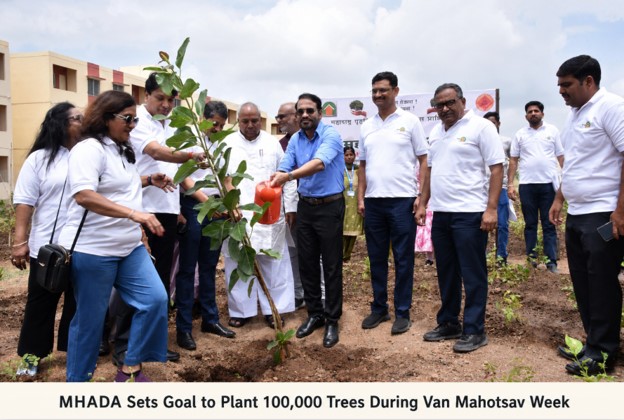
In a major push toward environmental protection and sustainable urban growth, the Maharashtra Housing and Area Development Authority (MHADA) has announced a large-scale tree plantation and conservation campaign across the state during the upcoming Van Mahotsav Week in July.
As cities continue to face challenges from rapid urbanization, rising pollution, climate change, and global warming, MHADA has set an ambitious target of planting 100,000 trees statewide. The initiative aims to create greener neighborhoods, strengthen biodiversity, and promote long-term environmental sustainability.
MHADA Focuses on Tree Conservation Along With Plantation
Speaking about the campaign, MHADA Vice President and CEO Sanjeev Jaiswal emphasized that planting trees alone is not enough.
He said that tree plantation should be seen as a long-term environmental responsibility for future generations and highlighted the importance of continuous care, monitoring, and preservation of every tree planted.
From July 1 to July 7, tree plantation programs will be carried out across multiple MHADA regional boards throughout Maharashtra. The campaign will prioritize planting native species, eco-friendly plants, and fruit-bearing trees to improve survival rates and encourage public involvement.
According to MHADA, fruit trees can help residents develop a stronger emotional connection with nature, increasing long-term care and participation.
Last Year’s Success Strengthens This Year’s Mission
Environmental conservation has become an important part of MHADA’s social responsibility efforts.
Last year, MHADA planted approximately 150,000 trees across Maharashtra. Around 80 percent of those trees continue to survive and are being actively maintained. Additionally, nearly 114,800 trees were successfully geo-tagged, allowing authorities to track their condition and growth over time.
Officials say these results demonstrate that the organization’s conservation-focused approach is producing measurable outcomes.
Local Communities to Play a Key Role in the Campaign
This year’s initiative places strong emphasis on public participation.
MHADA plans to involve:
· Local governing bodies
· Gram Panchayats
· Resident Welfare Associations (RWAs)
· Housing societies
· Environmental organizations and NGOs
· Citizens across Maharashtra
Officials stressed that environmental protection should evolve into a people-led movement rather than remain solely a government responsibility.
Urban Forests to Be Developed Using Miyawaki Method
As part of the campaign, MHADA will identify land parcels within the Mumbai Metropolitan Region that are unsuitable for construction and transform them into dense urban forests using the Miyawaki method.
This approach enables rapid growth of trees and supports rich biodiversity even within limited urban spaces. The initiative is expected to significantly improve green cover in highly developed areas.
Geo-Tagging and Long-Term Maintenance to Ensure Sustainability
Large-scale plantation activity will also take place across MHADA housing colonies, open plots, public areas, and project sites.
To ensure sustainability:
· Every planted tree will be geo-tagged
· Growth and conservation will be monitored regularly
· Plantation planning will avoid interference with infrastructure and building safety
· Long-term maintenance may be assigned to NGOs, resident groups, and local housing communities
These measures are intended to improve accountability and increase tree survival rates.
Encouraging Residents to Build Greener Communities
MHADA also plans to strengthen resident participation within completed housing projects by creating green zones in colonies.
The authority will encourage landowners to plant fruit trees on private land with consent, helping develop a stronger local sense of environmental responsibility and ownership.
Bigger and Healthier Saplings to Improve Survival Rates
This year’s plantation strategy will prioritize planting healthy saplings that are 5–6 feet tall and approximately 2–3 years old.
Officials believe this approach will improve tree survival, enhance carbon absorption, support biodiversity, and contribute to cleaner air and healthier living environments.
MHADA Calls for Public Support to Protect the Environment
Concluding the announcement, Mr. Jaiswal urged citizens to actively participate in tree plantation and conservation efforts.
He stated that collective action is essential to address rising pollution, climate change, and global warming, and encouraged communities across Maharashtra to contribute toward building a greener future.