
MHADA
MHADA Targets 13,091 Buildings in Mumbai Safety Overhaul
Mon Jun 22 2026
With 500 Structural Audit Reports Completed, Mumbai’s Aging Housing Stock Faces a Defining Moment
Mumbai’s identity has always been built vertically - but much of its history still stands horizontally in ageing cessed buildings spread across the city’s older neighborhoods. Every monsoon renews a familiar concern: how safe are these structures, and how quickly can risk be identified before it becomes crisis?
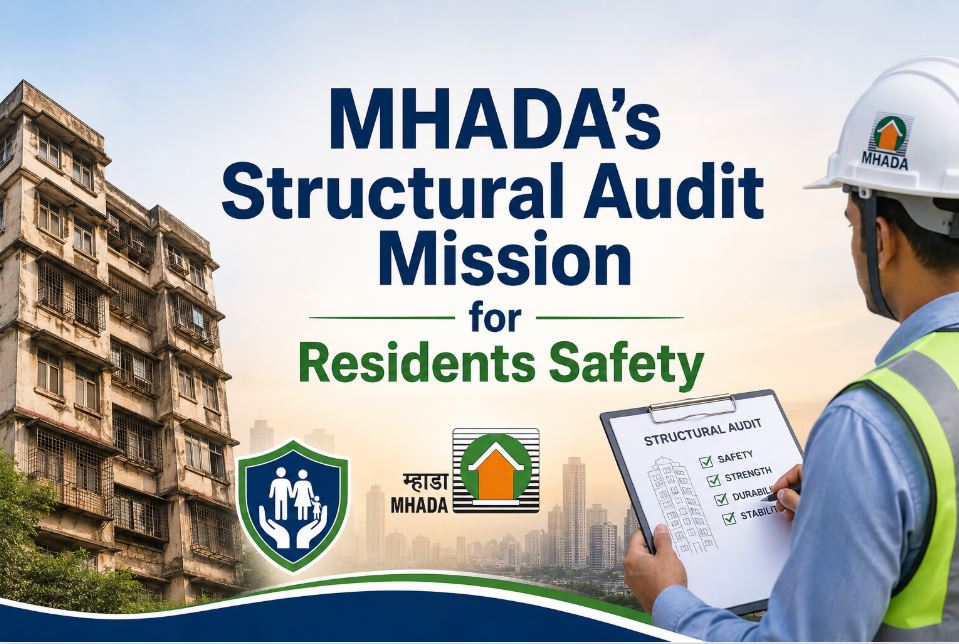
In one of the most focused preventive exercises underway in the city, IAS Sanjeev Jaiswal, serving as Vice President and Chief Executive Officer of MHADA, has accelerated efforts to bring greater accountability and scientific assessment to Mumbai’s old building ecosystem. The latest structural audit exercise marks an important step toward identifying risk across cessed properties and creating a framework for timely intervention rather than emergency response.
Highlight: Mumbai’s next phase of urban renewal may not begin with new towers - but with understanding which old buildings can safely survive.
Why Structural Audits Matter More Than Ever for Mumbai
Cessed buildings occupy a unique position in Mumbai’s urban landscape. Many of them were constructed decades ago and continue to house thousands of residents while operating under increasing structural stress.
The challenge is scale.
Out of a total of 13,091 cessed buildings across Mumbai, MHADA initiated structural audits for 500 buildings as part of a focused assessment programme. Rather than treating all structures as equally vulnerable, the exercise attempts to classify risk scientifically and create a prioritized action roadmap.
The significance of this approach lies in one simple shift: replacing assumptions with evidence.
MHADA’s Structural Audit Programme: Numbers That Reveal the Bigger Story
To execute the exercise efficiently, MHADA appointed 78 auditors to conduct structural assessments across selected cessed buildings.
The progress achieved so far indicates a stronger operational push than initially planned.
Although the target was structural assessment of 500 buildings, inspections were completed for 540 cessed buildings. Structural audit reports for 500 buildings have already been received and categorized.
The classification is as follows:
- C-1: 79 buildings
- C2a: 128 buildings
- C2b: 259 buildings
- C3: 34 buildings
These categories are more than administrative labels - they influence decisions around occupancy, repair priorities, redevelopment planning, and resident safety.
The largest share of audited buildings falls under the C2b category with 259 buildings, indicating that a substantial portion may require structural attention without necessarily reaching the most severe risk stage.
At the other end, 79 buildings have been classified as C-1, a category that typically signals the highest level of concern within structural assessment frameworks.
What This Classification Tells Us About Mumbai’s Housing Challenge
The audit outcomes highlight an important urban reality: ageing does not affect every building in the same way.
Urban policy often becomes reactive because problems are visible only after deterioration reaches a dangerous stage. Structural audits change that equation.
The distribution across C-1, C2a, C2b, and C3 categories suggests that Mumbai’s housing challenge is not simply about demolition versus preservation. It is about calibrated intervention.
Buildings with moderate structural concerns may benefit from repairs and maintenance, while severely distressed structures may need stronger redevelopment decisions. Without classification, both categories risk receiving the same treatment - which creates inefficiency and delays.
This is where data-driven governance becomes meaningful.
Beyond Compliance: Building Trust Through Preventive Urban Management
Infrastructure conversations often focus on roads, metros, and new projects. But urban resilience begins with the buildings people already live in.
By appointing 78 auditors and completing inspections beyond the original target, MHADA’s exercise demonstrates an operational mindset that values preventive governance.
For residents, structural audits create visibility.
For policymakers, they create prioritization.
For redevelopment agencies, they provide measurable inputs.
Most importantly, they reduce dependence on post-incident action.
The broader implication is equally important. If a structured audit model can be implemented across larger segments of the 13,091 cessed buildings, Mumbai could gradually move toward a continuous building health monitoring approach instead of periodic emergency reviews.
The Opportunity Ahead: Turning Assessment Into Action
Completing audits is only the first milestone.
The real impact will depend on how classification outcomes translate into repair schedules, resident communication, redevelopment planning, and administrative coordination.
Cities evolve through two types of investments - building new assets and preserving existing ones. Mumbai’s cessed building ecosystem requires both.
The current audit initiative creates an opportunity to establish stronger institutional processes around structural evaluation and urban safety. It also introduces a disciplined mechanism for identifying priorities at scale.
That matters because housing security is not only about creating new homes - it is also about ensuring existing homes remain safe.
Conclusion: A Data-Led Approach to an Old Urban Problem
Mumbai’s cessed buildings represent history, density, and housing necessity all at once. Managing them requires more than inspections after warning signs appear.
MHADA’s latest structural audit exercise - covering inspections of 540 buildings, receiving reports for 500, and categorizing them across four structural classes - signals a move toward evidence-based urban management.
The numbers may look administrative on paper, but their implications are deeply human.
In a city where millions depend on ageing built infrastructure every day, knowing the condition of buildings may become as important as constructing new ones.