
MHADA
MHADA's ₹9,000 Crore Housing Drive Gains Momentum
Mon Jul 13 2026
Highlight: A redevelopment strategy that combines housing expansion, rehabilitation, and public revenue is positioning MHADA's largest-ever cluster initiative as a defining moment for Mumbai's urban future.
MHADA's Mega Redevelopment Vision Signals a New Phase for Mumbai Housing
Mumbai's housing challenge has always been more complicated than simply building more homes. The city must simultaneously replace aging residential colonies, rehabilitate existing residents, unlock underutilized land, and create fresh housing supply for future buyers. The Maharashtra Housing and Area Development Authority (MHADA) is now attempting to address all these objectives through one of its most ambitious redevelopment initiatives to date.
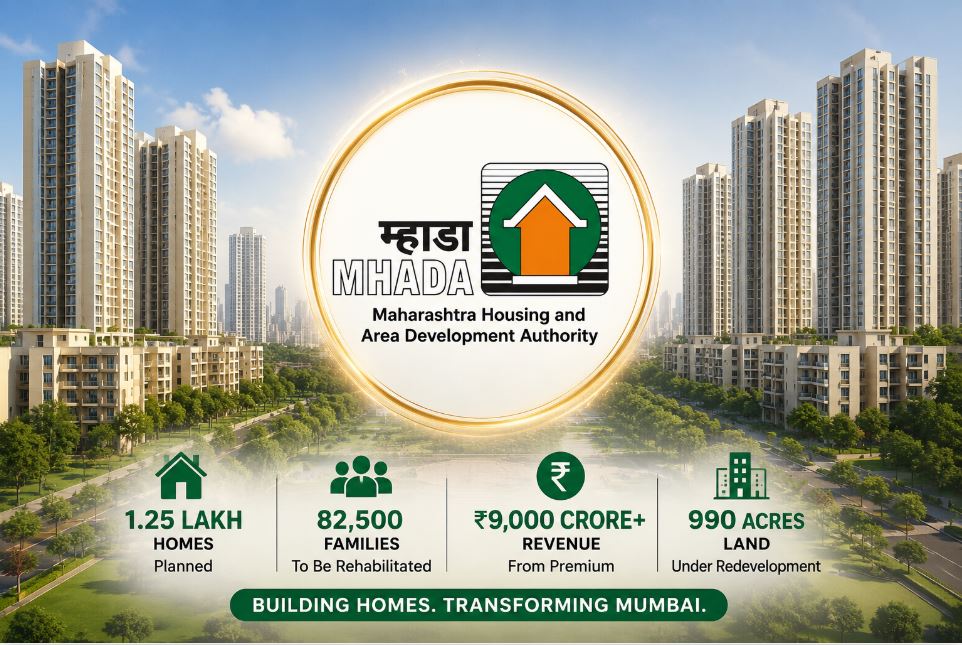
Under its large-scale group redevelopment program, MHADA plans to redevelop nearly 990 acres of land over the next seven to ten years, creating approximately 1.30 lakh homes. The initiative is expected to rehabilitate around 82,500 families currently living in MHADA colonies while generating more than ₹9,000 crore in premium revenue for the authority. If executed as planned, the project could significantly reshape Mumbai's housing landscape by balancing rehabilitation with new residential supply.
IAS Sanjeev Jaiswal Accelerates MHADA's Redevelopment Agenda
A major factor behind the project's rapid movement has been the leadership of IAS Sanjeev Jaiswal, Vice Chairman and CEO of MHADA. After the Maharashtra Government approved the policy allowing group redevelopment of plots measuring 20 acres or more through a Construction and Development Agency (CDA) on December 15, 2025, the tender process was initiated without delay.
This administrative speed reflects a shift from policy announcements to implementation. Rather than allowing approvals to remain on paper, MHADA quickly moved toward developer selection across multiple large redevelopment sites. The transition from approval to tendering is often where infrastructure and housing projects lose momentum, making this phase particularly significant.
Eleven Major Redevelopment Projects Move Ahead
The first phase of MHADA's redevelopment strategy covers 11 major projects spread across several prominent Mumbai neighborhoods.
Developers have already been appointed for redevelopment projects in:
- Abhyudaya Nagar (Kala Chowki)
- PMGP (Jogeshwari East)
- Motilal Nagar (Goregaon West)
- Kamathipura
- Guru Teg Bahadur Nagar
Meanwhile, the tender process has been completed for:
- Sardar Vallabhbhai Patel Nagar (Andheri West)
- Adarsh Nagar (Worli)
- Bandra Reclamation
- Aram Nagar (Versova)
In addition, redevelopment proposals for:
- Ramakrishna Nagar (Khar)
- Old MHB (Borivali)
have been submitted to the Maharashtra Cabinet for approval.
The geographic spread demonstrates that redevelopment is not concentrated in a single locality but is being planned across multiple parts of Mumbai, potentially creating a broader citywide impact.
More Than One Lakh Flats to Strengthen MHADA's Housing Supply
One of the most important outcomes of these initial 11 redevelopment projects is the scale of housing that will become available.
The projects are expected to provide approximately 1.08 lakh flats to MHADA.
This includes:
- 13,000 flats measuring 500 square feet
- 65,000 flats measuring 750 square feet
These homes will be available for sale, significantly increasing MHADA's future housing inventory.
A larger housing stock offers two important advantages. First, it expands purchasing opportunities for homebuyers seeking government-backed housing. Second, it enables MHADA to continue funding future redevelopment projects through revenue generated from housing sales and premiums.
Rehabilitation and Housing Supply Move Together
Urban redevelopment often faces criticism when rehabilitation and commercial interests appear to compete with one another. MHADA's redevelopment framework attempts to address both objectives simultaneously.
Across the larger 990-acre redevelopment program, approximately 82,500 rehabilitation flats will be created for existing residents.
Alongside rehabilitation, MHADA will receive approximately 28,000 flats for public sale.
In addition, nearly 1.30 lakh flats are expected to become available for open sale to Mumbai residents through the overall group redevelopment initiative.
This approach seeks to ensure that redevelopment does not merely replace existing housing but also contributes fresh supply to the broader residential market.
The Next Phase Expands the Redevelopment Footprint
The current projects represent only the beginning of MHADA's long-term redevelopment roadmap.
The next phase includes proposals for:
- Charkop – 240 acres
- Gorai – 256 acres
- Pratiksha Nagar, Sion – 29 acres
Once government approvals are secured, these additional projects will further expand MHADA's redevelopment footprint, bringing the authority closer to its larger vision of redeveloping nearly 990 acres under the cluster redevelopment model.
The phased approach also allows MHADA to build implementation experience while gradually increasing project scale.
Why This Redevelopment Model Matters
The significance of this initiative extends beyond the number of homes being built.
Mumbai contains many aging residential colonies where redevelopment has historically been slowed by fragmented ownership, financing challenges, and lengthy approval processes. Group redevelopment through larger land parcels offers the possibility of addressing these issues more systematically.
The model also creates multiple outcomes from a single intervention. Existing residents receive rehabilitated homes, MHADA gains revenue exceeding ₹9,000 crore through premiums, additional housing inventory enters the market, and large urban parcels are modernized under a coordinated redevelopment framework.
Equally important is the timing. Completing tender processes across multiple projects within months of policy approval suggests that institutional execution is receiving as much attention as policy design.
A Defining Test for Mumbai's Housing Future
MHADA's group redevelopment initiative represents one of the largest coordinated housing transformations currently underway in Mumbai. With approximately 1.30 lakh homes planned, rehabilitation for 82,500 families, redevelopment spanning 990 acres, and premium revenue expected to exceed ₹9,000 crore, the project combines urban renewal with long-term housing creation on an unprecedented scale.
The success of the initiative will ultimately depend on consistent execution across multiple redevelopment sites over the coming seven to ten years. If implementation continues at the current pace, the program could become a benchmark for how public agencies balance rehabilitation, housing supply, and financial sustainability while reshaping the future of one of India's most complex urban housing markets.