
Maharashtra
Mumbai: BMC to Clean 377 Roads Using Recycled Water
Tue Nov 17 2026
BMC Revives ₹8.25-Crore Mumbai Road-Washing Plan to Clean 377 Roads Using Recycled Water
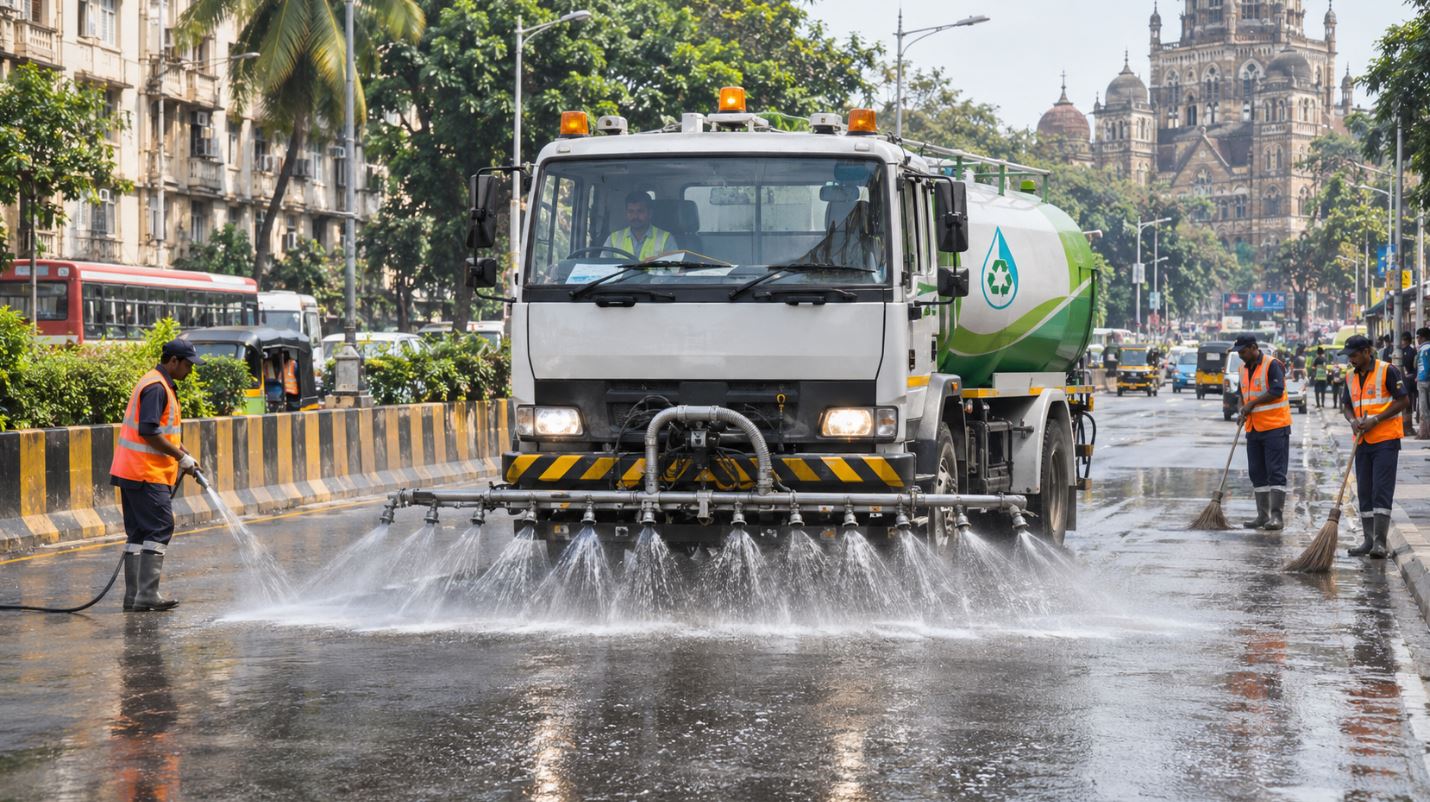
Mumbai’s civic administration has revived its ₹8.25-crore road-washing project to control dust pollution and improve road cleanliness across the city. The revised proposal will cover 377 roads with a combined length of 677 kilometers over 150 days. This time, the Brihanmumbai Municipal Corporation (BMC) has introduced an important change: contractors must use recycled water, well water, or borewell water instead of drinking water.
The updated proposal has been submitted to the BMC Standing Committee for approval. The initiative aims to reduce airborne dust, particularly PM10 particles, which contribute to Mumbai’s air pollution.
BMC Revises Road-Washing Proposal After Water Conservation Concerns
The BMC had previously proposed spending ₹8.25 crore on washing roads across Mumbai. However, the Standing Committee rejected the proposal in October because of concerns about water wastage during the city's ongoing water shortage and 10% water cut.
Following these objections, the civic body has revised its plan and introduced stricter conditions for water usage.
Under the new proposal, contractors will not be allowed to collect drinking water from BMC's regular potable water filling stations. Instead, they must arrange alternative water sources, including treated sewage water, wells, and borewells.
Contractors will also have to inform the BMC about the exact water sources they plan to use before starting the cleaning operations.
The revised approach is expected to help Mumbai control road dust while protecting the city's drinking water supply.
377 Mumbai Roads to Be Cleaned Across 677 Kilometers
The proposed road-washing drive will cover 377 roads across Mumbai, extending approximately 677 kilometers.
The BMC plans to deploy water tankers with different capacities, including:
- 2,000-liter water tankers
- 5,000-liter water tankers
- 10,000-liter water tankers
These vehicles will use high-pressure water systems to clean road surfaces and remove dust accumulated along roadsides.
The cleaning work will continue for 150 days, excluding the monsoon season. Priority will be given to major traffic routes, busy junctions, and road shoulders where dust frequently collects because of vehicle movement.
To avoid disrupting daily traffic, the BMC plans to carry out most cleaning activities during off-peak hours, particularly between 3 a.m. and 6 a.m.
Recycled Water to Reduce Pressure on Mumbai's Drinking Water Supply
One of the major changes in the revised project is the focus on non-potable water sources.
According to estimates, Mumbai generates approximately 2,190 million liters of sewage every day. The city is also working to improve its wastewater treatment and reuse infrastructure.
The BMC has stated that recycled water available from sewage treatment plants, along with water from wells and borewells, can support the proposed road-cleaning operations.
The estimated daily water requirement for washing 677 kilometers of roads is around 1.065 million liters, equivalent to 1.065 million liters or 1.065 MLD.
Contractors will be responsible for arranging their own tankers and ensuring that the water used meets the project's non-potable water requirements.
This measure is expected to support better water management while allowing the city to continue its dust-control efforts.
BMC Estimates ₹8.25 Crore for the 150-Day Cleaning Drive
The revised road-washing project carries an estimated expenditure of ₹8.25 crore.
Based on the previous project proposal, the approximate cost breakdown is:
Project Details
Estimated Figures
Total project cost
₹8.25 crore
Total roads covered
377
Combined road length
677 km
Project duration
150 days
Average daily expenditure
₹5.50 lakh
Cost per kilometer for 150 days
₹12,186
Cost per kilometer per day
₹81.24
These figures are approximate and may change depending on the final project approval and implementation requirements.
Road Dust Identified as a Major Contributor to Mumbai's Air Pollution
Road dust is one of the important sources of air pollution in Mumbai. Dust from construction sites, redevelopment projects, vehicles, and industrial activities can enter the air and affect its quality.
A 2018-19 Maharashtra Pollution Control Board study identified road-dust resuspension as a major contributor to particulate pollution.
According to the study:
- Road-dust resuspension contributes around 30% of particulate pollution.
- Marine particles account for approximately 18% of PM10 and 26% of PM2.5 pollution.
- Construction activities contribute around 9%.
- Vehicular emissions contribute approximately 9%.
The BMC started road-washing activities in November 2023 following directions from the state government. The latest proposal is another step toward strengthening the city's dust-control measures.
How Will the BMC Monitor the Results of Road Washing?
The civic body plans to evaluate the effectiveness of road washing by monitoring dust levels before and after cleaning.
Officials will observe how long roads remain relatively dust-free after washing and how quickly dust builds up again.
The BMC also has other dust-control equipment, including vehicle-mounted dust-suction machines, road sprinklers, fogging systems, and misting equipment.
These measures can work together to reduce dust particles released into the air by traffic and other activities.
Can Road Washing Improve Mumbai's Air Quality?
Regular road washing can help reduce airborne road dust, especially PM10 particles. However, it is not expected to solve all of Mumbai's air pollution problems on its own.
Construction work, vehicle emissions, industrial activities, and waste burning also contribute to poor air quality. Therefore, road washing needs to be supported by stronger pollution-control measures across different sectors.
Environmental activist Stalin D has also supported regular road cleaning as a useful dust-control practice. He pointed out that dust often collects along road shoulders because of continuous vehicle movement. Cleaning these areas early in the morning can help prevent dust from becoming airborne during the day.
BMC Focuses on Cleaner Roads and Better Environmental Management
With the revised ₹8.25-crore proposal, the BMC aims to strengthen Mumbai's road-cleaning system while addressing concerns about drinking water consumption.
The planned coverage of 377 roads across 677 kilometers could help improve road cleanliness and control dust in busy parts of the city.
The use of recycled water and other non-potable sources is an important feature of the updated plan. Once the Standing Committee grants approval, the civic body can move ahead with the proposed 150-day cleaning drive.
The initiative reflects Mumbai's continuing efforts to improve urban cleanliness, manage dust pollution, and support a healthier environment for residents.