
Maharashtra
World Earth Day 2026: India’s Ethanol Push Signals Green Shift, But Vehicle Readiness Remains A Challenge
Thu Apr 23 2026
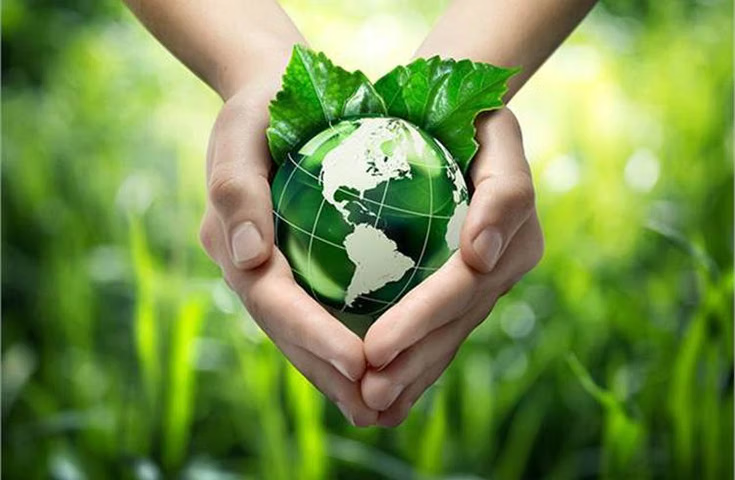
New Delhi: As the world marks Earth Day 2026 under the theme “Our Power, Our Planet,” India is positioning itself at the forefront of clean energy transition with its aggressive push toward ethanol-blended fuels.
Following the nationwide rollout of E20 petrol (20% ethanol blend) earlier this month, Union Minister Nitin Gadkari has now set an ambitious goal—moving towards 100% ethanol-based fuel in the future.
Why India Is Betting Big On Ethanol
India’s ethanol strategy is driven by both economic and environmental priorities.
The country currently imports nearly 87% of its crude oil, costing an estimated ₹22 lakh crore annually
Ethanol, produced domestically from crops and agricultural waste, helps reduce dependence on global oil markets
It also supports farm incomes by creating demand for surplus produce
From an environmental perspective, ethanol is a cleaner-burning fuel. According to the Ministry of Petroleum and Natural Gas, the blending programme has already reduced CO₂ emissions by nearly 736 lakh metric tonnes—equivalent to planting millions of trees.
Performance vs Efficiency: The Real Trade-Off
For everyday drivers, ethanol-blended fuel presents a mixed experience.
Advantages:
Higher octane rating (RON ~108) improves engine performance
Reduces engine knocking and ensures smoother acceleration
Challenges:
Lower energy density leads to 3–7% drop in fuel efficiency
Mileage-conscious users may feel the impact in daily driving costs
This creates a practical dilemma: cleaner fuel vs slightly higher fuel consumption.
Concerns For Older Vehicles
The biggest hurdle lies with vehicle compatibility, especially for cars manufactured before 2023.
Ethanol has properties that can affect older engines:
- It absorbs moisture, increasing risk of internal corrosion
- Can degrade rubber seals, gaskets, and plastic components
- Long-term exposure may impact fuel systems not designed for high ethanol blends
While maintenance solutions exist, they add extra cost and attention for vehicle owners.
The Future: Flex-Fuel Vehicles
India’s long-term ethanol vision depends on Flex-Fuel Vehicles (FFVs)—cars designed to run on any mix of petrol and ethanol.
Countries like Brazil have successfully adopted FFVs, making them a proven model for large-scale transition.
However, scaling this in India will require:
- Automakers to prioritise FFV production
- Consumer awareness and acceptance
- Infrastructure upgrades
- Food vs Fuel Debate
The ethanol push also raises a critical question—should food crops be used for fuel?
Critics warn that excessive reliance on grains like maize and rice could affect food supply. To address this, India is exploring second-generation (2G) ethanol, made from agricultural waste instead of edible crops.
What Drivers Should Do Now
- As India transitions, vehicle owners can take a few practical steps:
- Check if their vehicle supports E20 fuel compatibility
- Avoid storing fuel for long periods (over 90 days)
- Schedule regular servicing for fuel system inspection
- Stay updated on manufacturer guidelines
Conclusion
India’s ethanol roadmap marks a significant step toward cleaner energy and self-reliance, aligning with global sustainability goals.
However, the journey to 100% ethanol is not just about policy—it requires technological readiness, consumer adaptation, and careful balancing of economic and environmental priorities.
For now, the shift represents a promising green win—but one that comes with real-world challenges for millions of motorists.