
MHADA
MHADA Tathawade Phase 2 Flats Offer Fresh Home Opportunity
Thu Jul 23 2026
Highlight: By easing eligibility for middle income buyers while retaining modern amenities, MHADA is turning unsold inventory into a wider homeownership opportunity for Pune families.
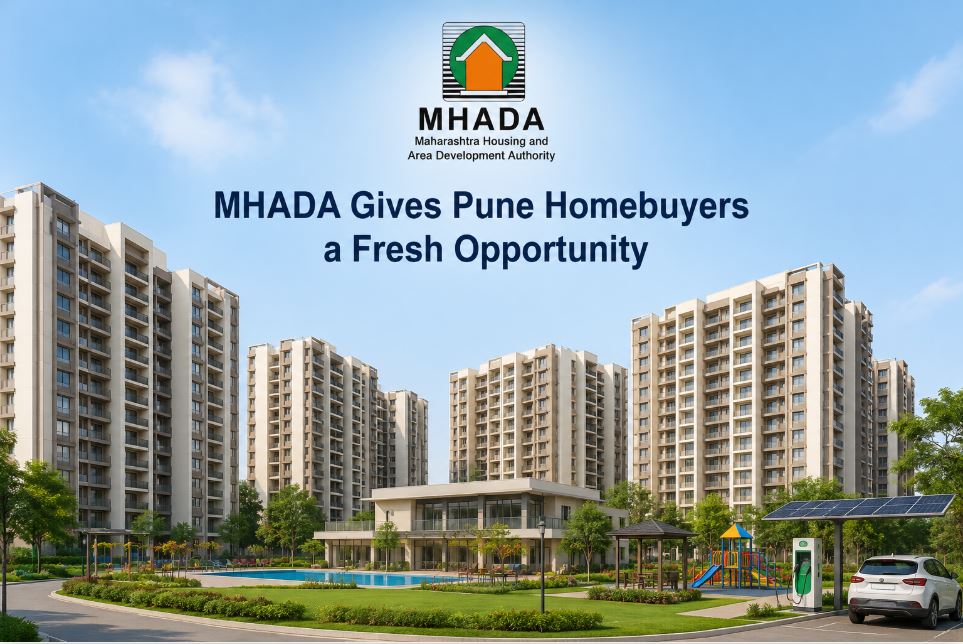
MHADA Gives Pune Homebuyers a Fresh Opportunity
The Maharashtra Housing and Area Development Authority (MHADA) has reopened one of Pune's significant affordable housing opportunities by issuing a second advertisement for the sale of 634 flats under its Tathawade Phase 2 housing scheme. The decision comes after the first round of allotments left a large number of homes unsold despite strong public interest. This time, MHADA has introduced a key policy change by relaxing the income eligibility criteria for the Middle Income Group (MIG), making the scheme accessible to a larger section of aspiring homebuyers.
Under the leadership of IAS Sanjeev Jaiswal, Vice President and Chief Executive Officer of MHADA, the authority has increasingly focused on expanding access to planned and affordable housing across Maharashtra through practical policy measures. The Pune Housing and Area Development Board's latest decision to ease income conditions for the MIG category reflects this broader approach of making government housing schemes more inclusive while improving the pace of allotments. The initiative reinforces MHADA's long term objective of matching housing supply with the needs of eligible citizens.
Why MHADA Issued a Second Advertisement
The Pune Housing and Area Development Board officially launched the second advertisement during a program held at Bharat Ratna Dr Babasaheb Ambedkar Hall. Board Chairman Shivajirao Adhalrao Patil announced that online registration and application submission for the computerized lottery have already begun through MHADA's official lottery portal.
The scheme covers 634 residential flats located at Survey No. 126+127/1 in Tathawade, Pune.
The most notable change is the relaxation of income eligibility for the Middle Income Group category. According to Adhalrao Patil, this move is intended to encourage more citizens to participate and secure an affordable home through MHADA's transparent lottery system.
Rather than allowing completed housing inventory to remain vacant, the revised eligibility criteria aim to improve participation while ensuring that more families can benefit from government backed housing.
Understanding What Happened in the First Lottery
The second advertisement follows the outcome of MHADA's earlier sale process launched in April 2026.
In the first phase, MHADA offered a total of 792 flats comprising:
- 24 flats under the Low Income Group (LIG)
- 768 flats under the Middle Income Group (MIG)
The response showed an interesting contrast between demand and actual acceptance.
For the 24 LIG flats, MHADA received 438 applications, indicating strong demand from lower income households.
However, for the much larger inventory of 768 MIG flats, only 304 applications were submitted.
Among the successful applicants selected through the lottery, only 135 ultimately accepted their allotments. As a result, the Board is currently distributing only 150 flats from the original 792-unit offering.
This left a substantial inventory available for resale.
The newly announced advertisement therefore covers:
- 1 remaining LIG flat
- 633 remaining MIG flats
Together, these account for the 634 flats now being offered under the second round.
Relaxed Income Criteria Could Improve Participation
The decision to relax income conditions for MIG buyers is perhaps the most significant policy element in this announcement.
Affordable housing schemes often face a mismatch between eligibility rules and actual market demand. Even when pricing remains attractive, restrictive income thresholds can prevent otherwise capable buyers from participating.
By widening eligibility, MHADA is attempting to bridge this gap without changing the housing product itself.
The strategy could help accelerate occupancy while allowing more middle income households to access professionally planned residential communities at government determined prices.
For Pune, where residential demand continues to evolve across emerging suburban locations, greater flexibility in eligibility may improve both buyer confidence and scheme performance.
Pricing Keeps the Scheme Within Reach
The Tathawade Phase 2 project offers different price points for LIG and MIG buyers.
The lone remaining Low Income Group flat is priced between ₹46 lakh and ₹47 lakh, with a built up area ranging from 75.96 square meters to 77.99 square meters.
The 633 Middle Income Group flats are priced between ₹64.50 lakh and ₹65.50 lakh. Their construction area ranges from 89.15 square meters to 91.18 square meters.
These standardized pricing bands provide transparency for applicants while allowing buyers to evaluate costs before participating in the lottery process.
Modern Amenities Add Long Term Value
The housing scheme is not limited to providing residential units alone.
Each flat includes one dedicated four wheeler parking space, addressing a practical concern for urban households.
The project also incorporates several lifestyle and sustainability focused facilities, including a swimming pool, clubhouse, indoor games area, children's play area, open gym, solar energy based on grid solar systems, electric vehicle charging facilities, and rainwater harvesting infrastructure.
These amenities indicate MHADA's continued effort to develop integrated residential communities rather than standalone housing blocks.
Such features also support the growing expectation that affordable housing should deliver quality of life alongside affordability.
What This Means for Pune's Housing Market
The second advertisement is more than a routine reopening of applications. It reflects how housing authorities can respond when initial market outcomes differ from expectations.
Instead of treating unsold inventory as a setback, MHADA has adjusted policy where necessary while preserving transparency through its computerized lottery system.
The approach demonstrates that affordability depends not only on pricing but also on eligibility, accessibility, and administrative flexibility.
If the relaxed income criteria successfully increase participation, the Tathawade experience may offer useful lessons for future government housing projects across Maharashtra.
It also highlights the importance of continuously evaluating housing schemes after launch rather than assuming initial demand accurately reflects long term market potential.